
Part 1 – Social Media Storytelling Is Having an Identity Crisis

Ariel Aarenau
Dec 6, 2022 (published January 27, 2023) · 3 min read

Simply put, Facebook, Instagram, and Twitter have each spent over a decade as the unencumbered market leaders in social media storytelling – that is, until recently with the unparalleled rise of TikTok and emerging growth of BeReal.

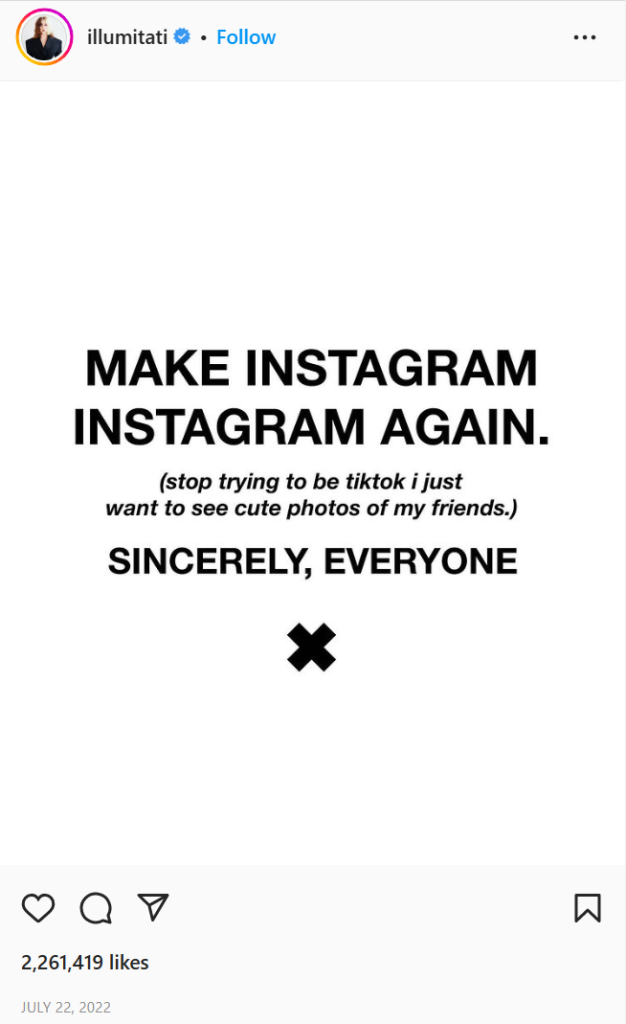
It is my belief that these platforms lost their unique storytelling capabilities as they grew into catch-all services. In a world where the “medium is the message,” (McLuhan & Fiore, 1976) creators continue to seek mediums that allow them to effectively leverage the unique affordances found within a given platform. After a decade of social media supremacy, TikTok has successfully delivered on that and is filling a void in storytelling left by the mainstream social media players.
Over the course of this series, I will spotlight how Facebook, Instagram, and Twitter once afforded users with a form of unique, constraint-driven storytelling now found within TikTok and BeReal. I will delve into each platform’s history and articulate how these platforms’ desire to be everything platforms turned them into nothing platforms. Finally, you will hear from two fellow BMPD students – Lea, a rising TikTok content creator, and Alicia, an avid BeReal user – as I work to pinpoint what specifically these platforms provide that Facebook, Instagram, and Twitter no longer do.
Ariel Aarenau is in his final year of the Bachelor of Media Production and Design program at Carleton University where he is also minoring in Business. The fusion of digital media, design thinking, and innovative business technologies combines both his strengths and passions. He currently works at Deloitte as a Business Analyst focusing on digital strategy, innovation, and transformation advisory projects. Prior to joining Deloitte, Ariel held roles in Multimedia Services at the House of Commons of Canada, Marketing and Business Development for Deloitte Israel, and the Digitally Assisted Storytelling division of Carleton Immersive Media Studio.
Paul, L. (2022, July 26). Instagram caves and walks back changes after Kim Kardashian, Kylie Jenner called for app to stop copying TikTok. Rolling Stone. Retrieved October 27, 2022, from https://www.rollingstone.com/culture/culture-news/kim-kardashian-kylie-jenner-want-instagram-to-stop-copying-tiktok-1388110/
McLuhan, M., & Fiore, Q. (1967). The medium is the massage. New York, Bantam Books.
Waters, R., & Murphy, H. (2022, April 16). Elon Musk fails to convince the doubters that he will ‘save’ twitter. Financial Times. Retrieved October 27, 2022, from https://www.ft.com/content/bdaa0a37-9f4f-4bcc-8f3a-ca9261186e8c
Lopatto, E. (2022, July 26). Adam Mosseri confirms it: Instagram is over. The Verge. Retrieved October 27, 2022, from https://www.theverge.com/2022/7/26/23279815/instagram-feed-kardashians-criticism-fuck-it-im-out
More Stories

Part 5 – With Facebook, Instagram, and Twitter in Crisis, A New Generation of Apps Emerges
With Facebook, Instagram, and Twitter each in a state of disrepair, it should be no surprise that competitors are not just emerging but taking off. The first and most prominent competitor is TikTok, an international version of Douyin, which was released in the Chinese market in September 2016. TikTok was then released worldwide following a merger of its parent company with Musical.ly on August 2, 2018.

Part 4 – A Little Birdy Told Me Twitter Is Lost
I write this post amidst ongoing chaos at Twitter HQ. It is November 21, 2022, and a few dozen more Twitter employees have flown away from the nest. Elon Musk is the company’s “Chief Twit”, and his latest decision to reinstate former President Trump’s Twitter account has the world chirping. Since Musk’s ownership, Twitter has shed 60% of its employees between layoffs and attrition, cut 80% of its contractors, and experienced a humiliating Twitter Blue product reconfiguration.

Part 3 – Can We #ThrowbackThursday Our Way to the Old Instagram?
Founded in 2010 by Kevin Systrom and Mike Krieger, Instagram was an instant success. The app reached over one million users just two months after its release and reached ten million users in its first year. In some respects, its success should have been anything but a surprise: Mark Zuckerberg was an early courter, Jack Dorsey was an avid user, and Marc Andreessen and Chris Sacca had advised from the sidelines.

© Copyright 2022. Carleton University School of Journalism and Communication. All rights reserved.