2023 Winter

Jay Odiick
Invited by Danielle Printup
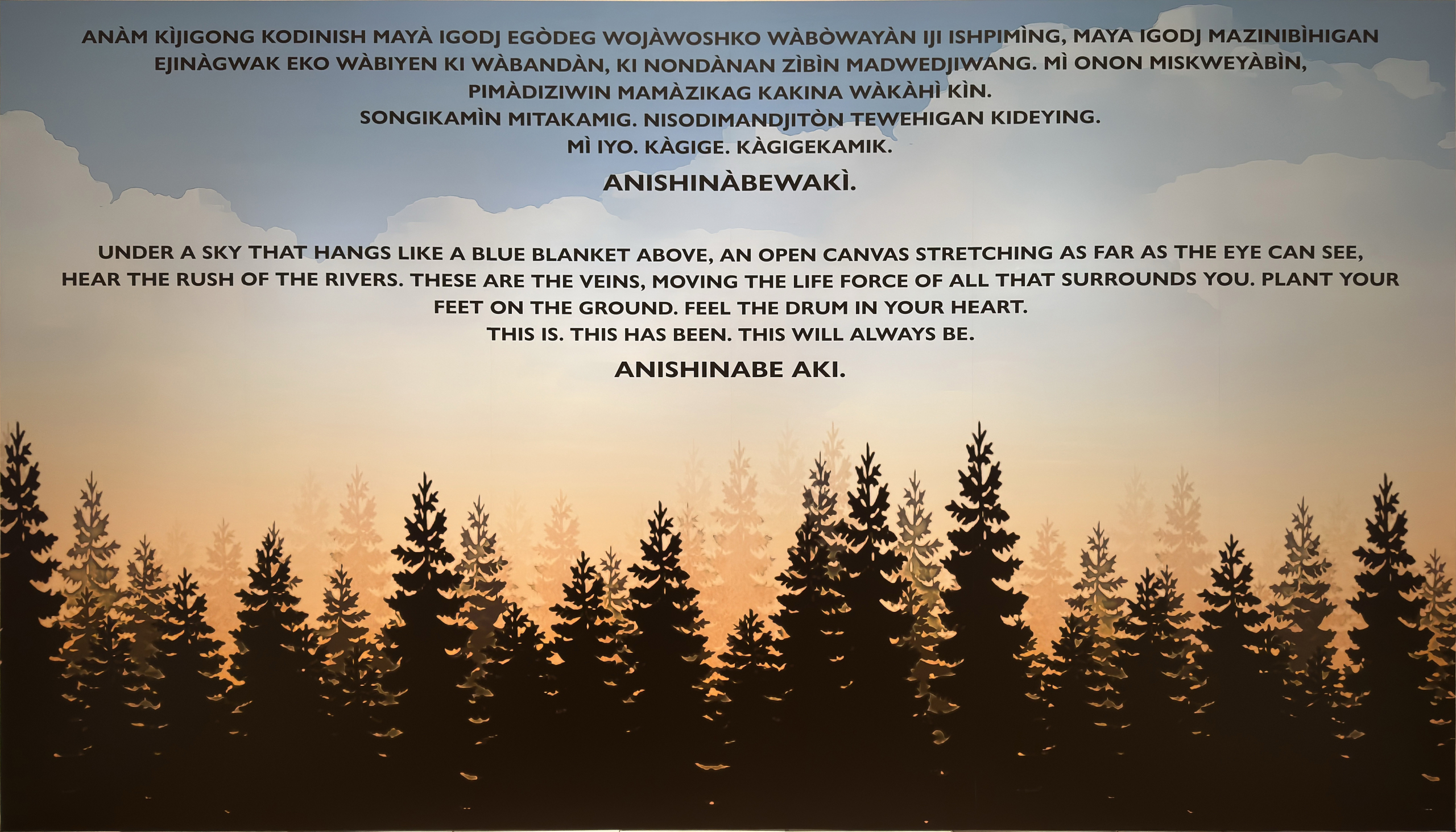
Anishinäbewaki / Anishinabe Aki, 2022
Courtesy of the artist
Danielle writes:
The Algonquin artist, writer and television producer lay Odick combines his drawing and writing practices in this new work to express his deep relationship to Anishinabe Aki: the land. Odfick brings this connection to life through language, imagery and colour.
Odjick’s monumental digital drawing depicts a serene landscape filled with large pine trees that fade into the distance, suffused by a foggy blanket of warm sunlight. Hovering above the trees is a light blue sky full of floating clouds that drift upwards.
The calm, tranquil feel of Odick’s forestscape is countered by a short poem he wrote, offered both in English and Algonquin. His writing is potent and declarative, urging us to conceptualize land through embodied, sensory experiences. The emotional and physical weight of his words, printed in bold type, contrasts the peaceful ambience generated by the drawing. While his drawing invites viewers into the work, his poem speaks to them directly.
Incorporating this poem in Algonquin animates the original language of this territory. Reproduced at an immense size, this work powerfully embodies odick’s profound tribute to the land that his people, the Algonquin Nation, have cared for since time immemorial. In creating this work, Odjick makes visible the connections that have always been and will continue to be, the foundation of Anishinabe Aki.
Anirnik Oshuitoq (Kinngait, 1902-83)
Untitled (1976)
Felt-tip pen on paper
The Priscilla Tyler and Maree Brooks
Collection of Inuit Art
This striking drawing is the gift of American collectors Priscilla Tyler and Maree Brooks. Marion (Mame) Jackson, a scholar and professor of Inuit art at Carleton, facilitated this donation to the University in 1992…Read More
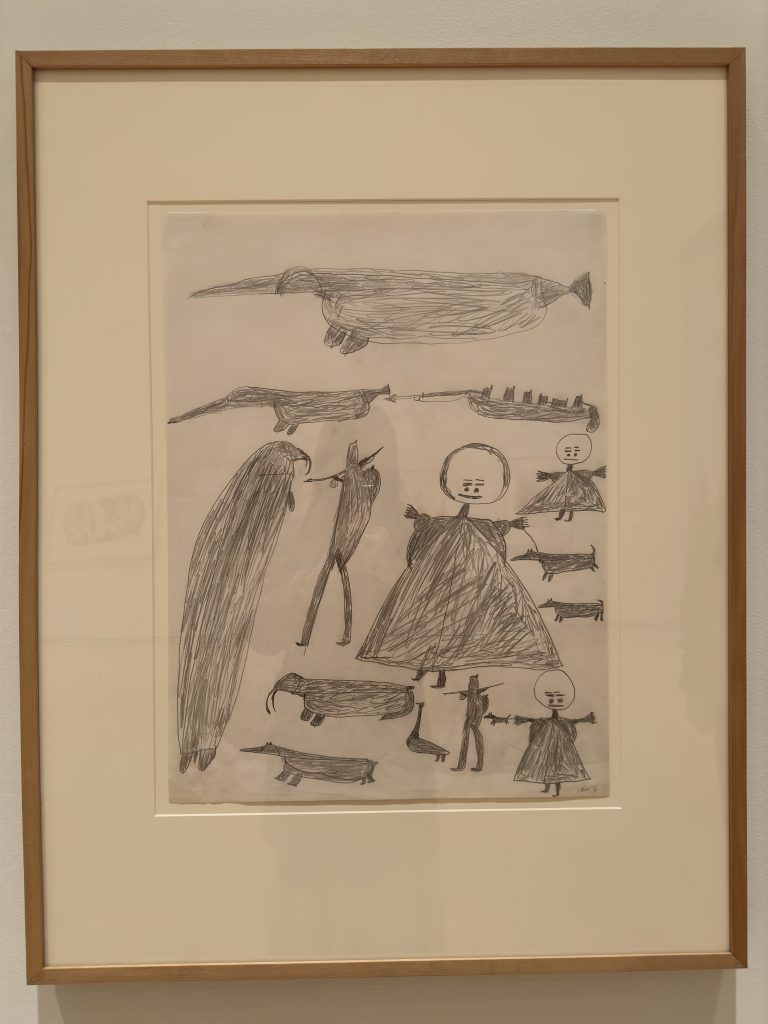
Parr (Kinngait, 1893-1969)
Untitled (1961)
Graphite on paper
Gift of Drew and Carolle Anne Armour, 2009
Parr was in his late sixties when he moved to Kinngait in 1961 and began working as an artist. He drew from life and memory to make spare and remarkable images that mostly depict the hunt, hunters and the hunted…Read More
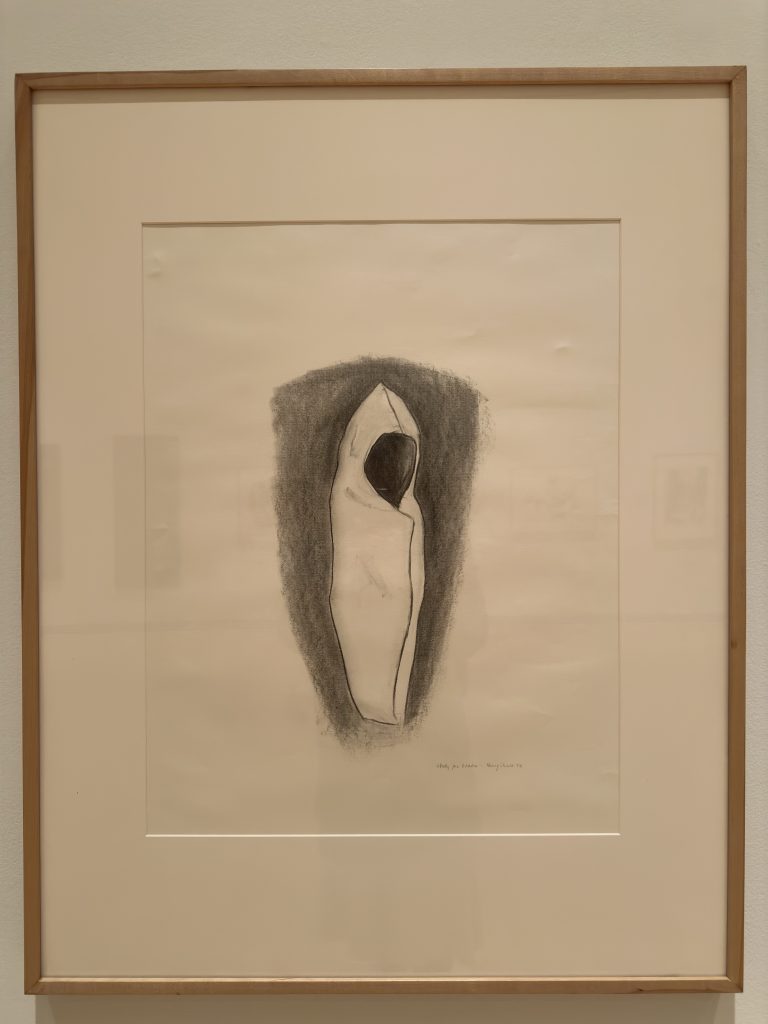
Faye HeavyShield (b. 1953)
Kainai (Blood) Nation
Study for “Cradle” (1992)
Graphite on paper
Gift of Victoria Henry, 2002
A prominent multidisciplinary artist based in Southern Alberta, Faye HeavyShield is a member of the Kainai (Blood) Nation, which is part of the Blackfoot Confederacy…Read More

Janet Kigusiuq (Qamani’tuaq, 1926-2005)
Untitled (c. 1985)
Graphite and coloured pencil on paper
Purchase, 1986
The Austrian-born scholar and émigré George Swinton developed a passion for the work of Inuit artists on his inaugural journey to Inuit Nunangat in 1957. He taught the first course in Inuit art, at the University of Manitoba in 1971…Read More

Kenneth Lochhead (Canadian, 1926-2006)
Gatineau Stream (1980)
Pastel on paper
Gift of Kenneth Lochhead, 1999
Kenneth Lochhead gained renown while a member of the Regina Five, a group of abstract artists active through the 1950s. Lochhead’s interest shifted to landscape painting in the late 1970s and early 1980s…Read More
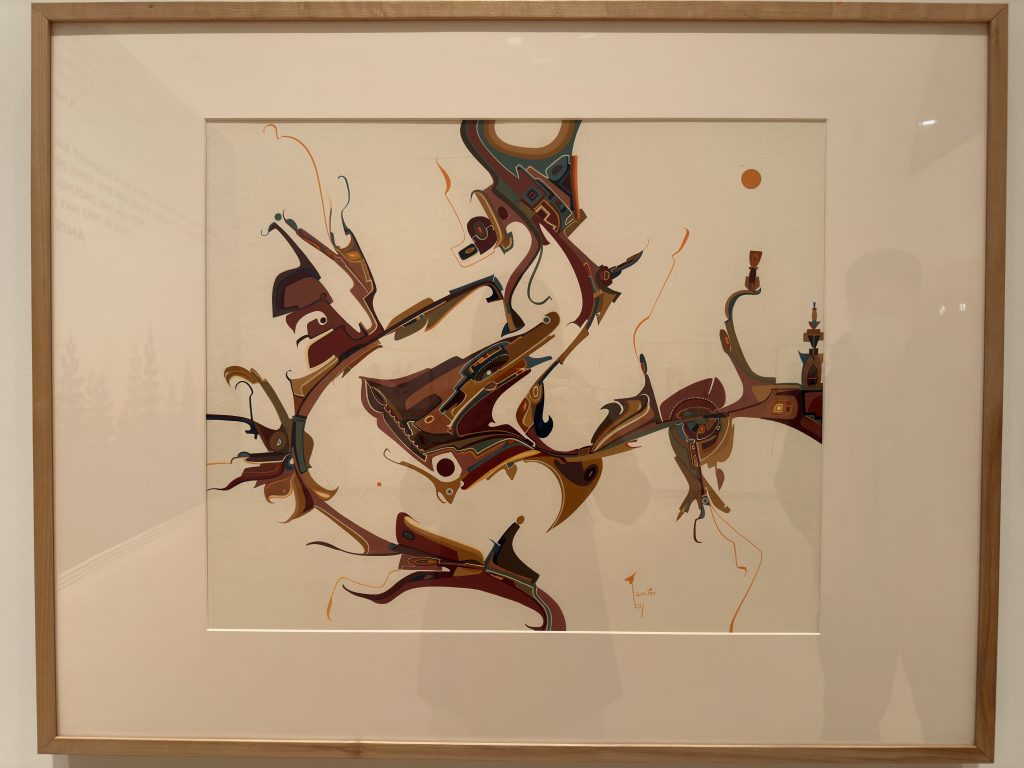
Alex lanvier (b. 1935)
Cold Lake First Nation
Be Kind to Animals (1976)
Gouache on paper
Gift of Hans and Béla Adler
Alex Janvier is a world-renowned Denesuline artist from Cold Lake First Nation in Treaty 6 territory. He was one of the founders of Professional Native Artists Inc…Read More
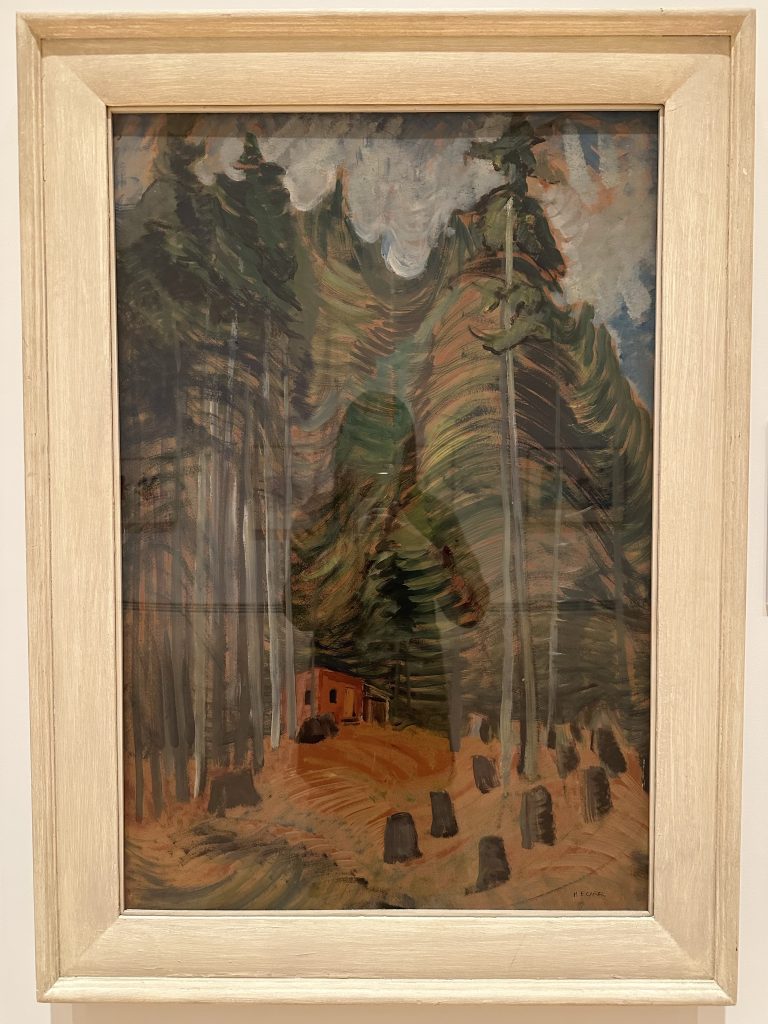
Emily Carr (Canadian, 1871-1945)
Glade and House (prior to 1945)
Oil on paper
Gift of Jack and Frances Barwick, 1985
With its rhythmic brushstrokes and monumental trees, Glade and House demonstrates Emily Carr’s loose, expressive approach to painting on paper, in keeping with the large scale of the environment on British Columbia’s…Read More
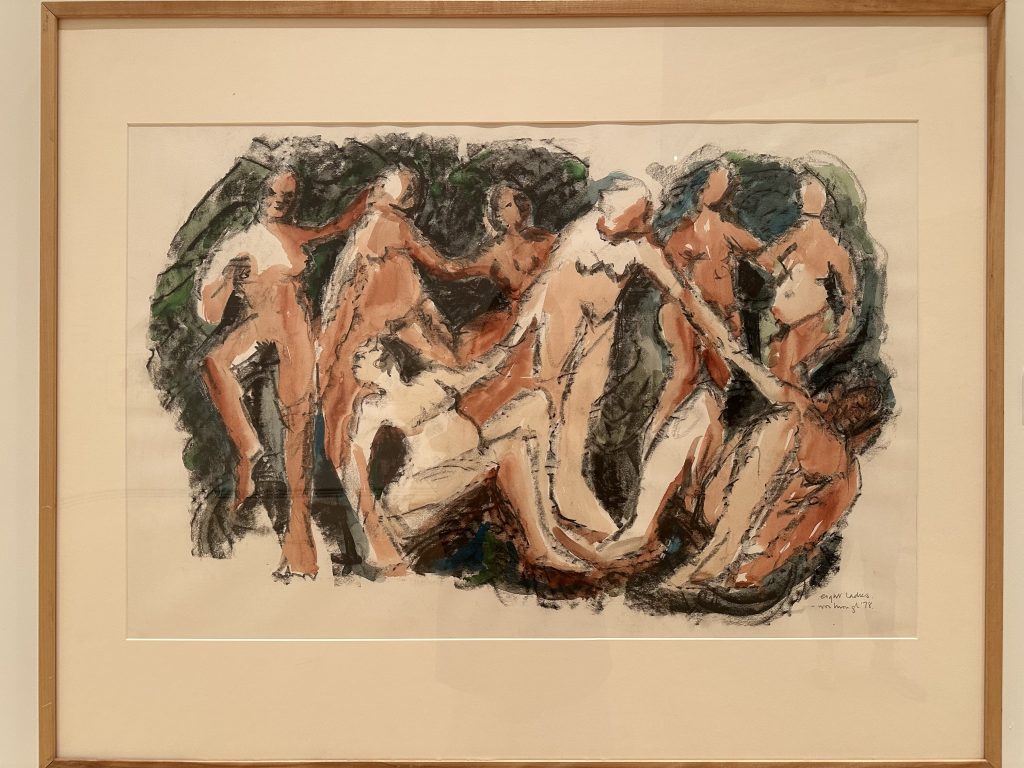
Hilda Woolnough (Canadian, 1934-2007)
Eight Ladies (1978)
Watercolour and graphite on paper
Gift of Gary Bomza, 1998
There is NO textual explanation for this artwork

Marigold Santos
woven talisman (cold dusk), 2014
Charcoal and pastel on Japanese paper
Courtesy of the artist and Norberg Hall
There is NO textual explanation for this artwork

Marigold Santos
woven talisman (magic hour), 2014
Charcoal and pastel on Japanese paper
Courtesy of the artist and Norberg Hall
There is NO textual explanation for this artwork
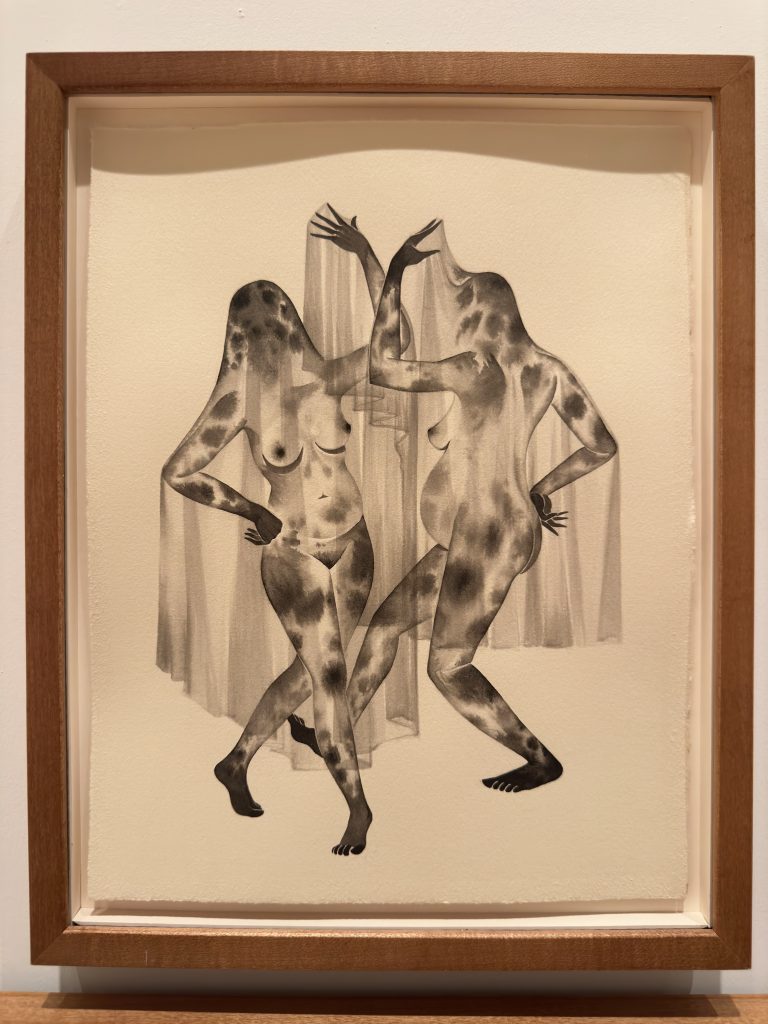
Marigold Santos
shroud (buntis na erotika) I, 2021
Ink on paper
Courtesy of the artist and Norberg Hall
There is NO textual explanation for this artwork
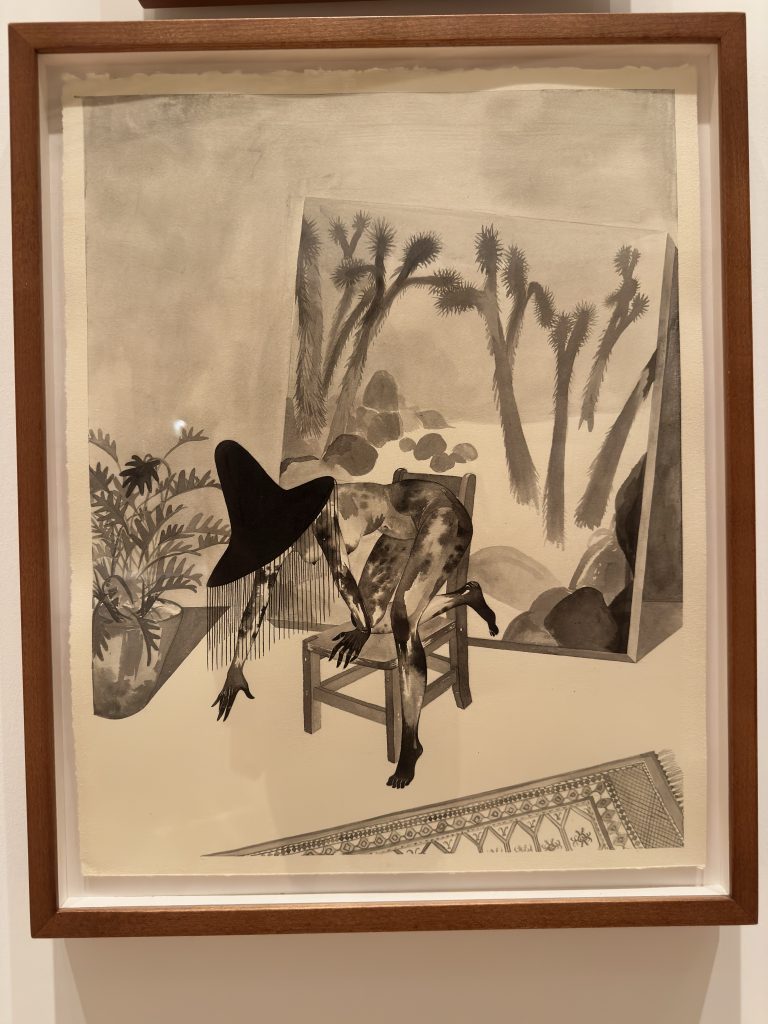
Marigold Santos
shroud (arid interior I), 2018
Ink on paper
Private collection, courtesy of Norberg Hall
There is NO textual explanation for this artwork

Marigold Santos
shroud envisioning (glance in green), 2022
Acrylic, pigment and black gesso on canvas
Private collection, courtesy of Norberg Hall
There is no textual explanation for this artwork

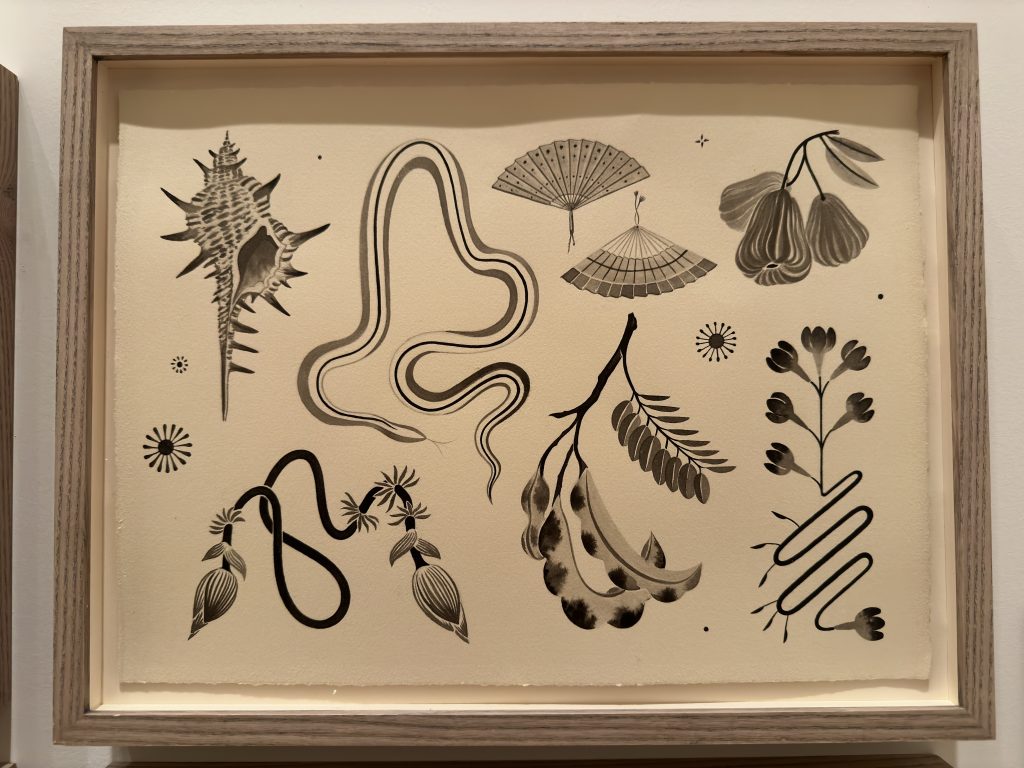
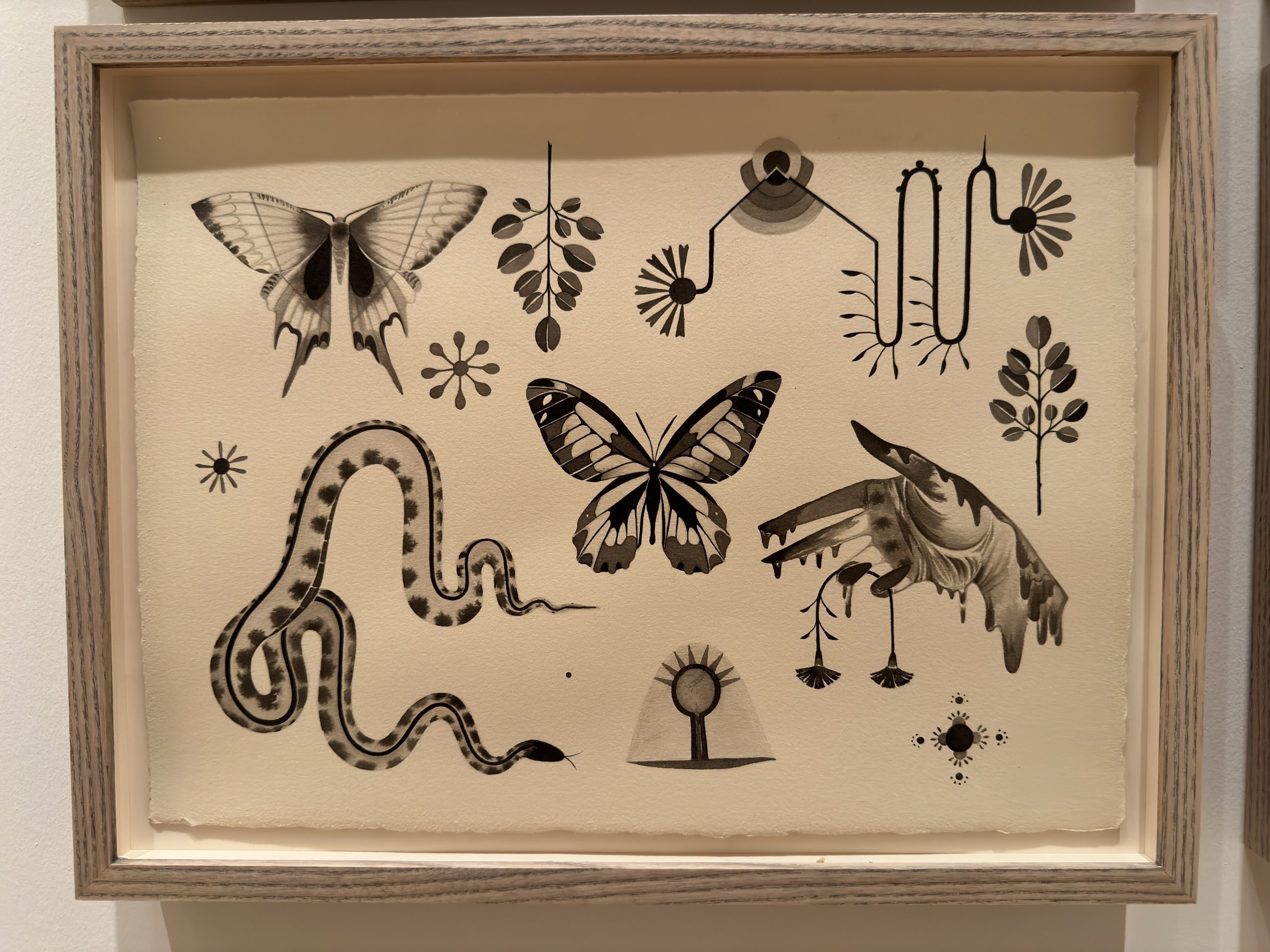

Marigold Santos
top row from left:
Ink Gathering (5), 2021
Ink Gathering (7), 2021
bottom row, from left:
Ink Gathering (6), 2021
Ink Gathering (8), 2021
Ink on paper
On loan from the TD Bank Corporate Art Collection

Marigold Santos
Invited by Alice Ming Wai Jim
Alice writes:
Marigolds thrive in the arid climates of Marigold Santos’s desert
her studio depicted in the ink drawing shroud (arid interior 1). The scene also affords us a glimpse of the artist’s take on the asuang (aswang), a traditionally terrifying shapeshifting creature of Filipino folklore.
Multiple configurations of this powerful, amorphous being populate Santos’s drawings and ceramics. Her reimagined aswang figures appear in numerous poses and positions – their shrouds at times made of thick dark masses, mystical woven textiles or braided voluminous hair, or exchanged for large-brimmed veiled hats of different styles.
The asuang mythology arose from the Babaylan – pillars of society as shamans and healers in pre-colonial Philippines – whose meaning and purpose were inverted by the Spanish colonizers. Reconfigured again, Santos’s asuang figure is hybrid in state and status, negotiating strata and longing, becoming land; these are not uncommon preoccupations today, during eras of migration and diaspora.
The blemishes or ink spots, or perhaps striae or scars, all over their bodies are more than skin deep. They tell stories, the narratives that make a life legible to oneself and to others. A form of permanent body adornment, tattooing was a prevalent cultural practice passed down in all ethnic groups of the Philippine Islands before they were colonized in the sixteenth century.
Super enlarged tattoo motifs of the artist’s design monumentalize this living art form as a cutaneous archive of ancestral knowledge that Filipinos are reviving today as a vibrant, decolonial practice.
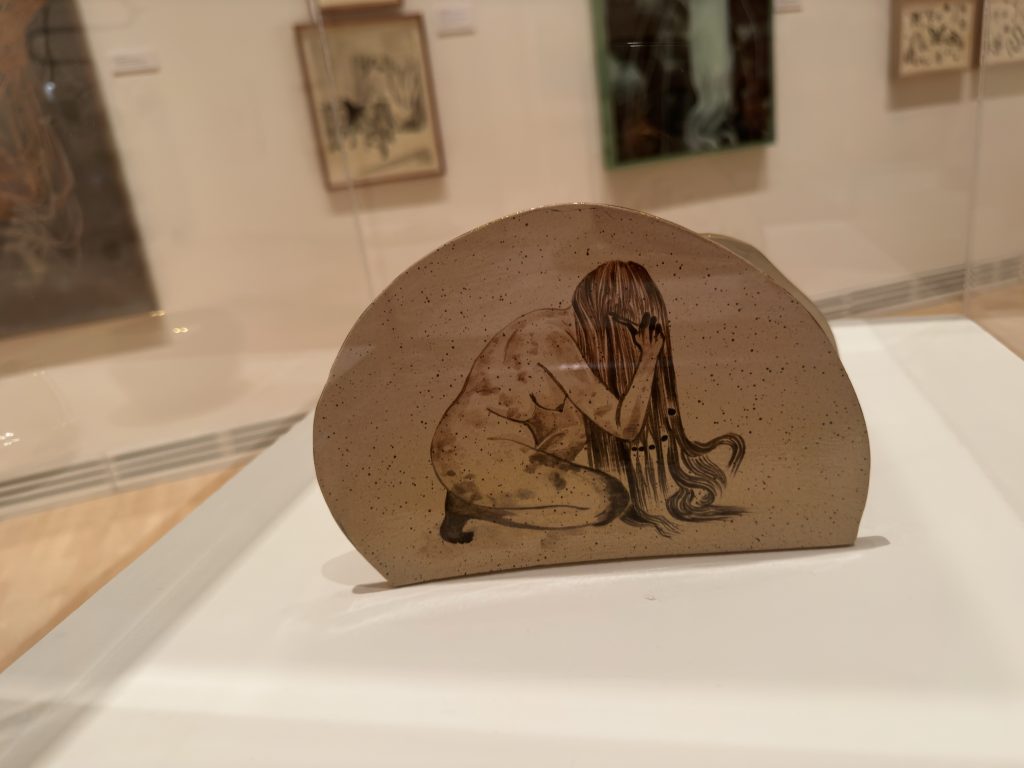
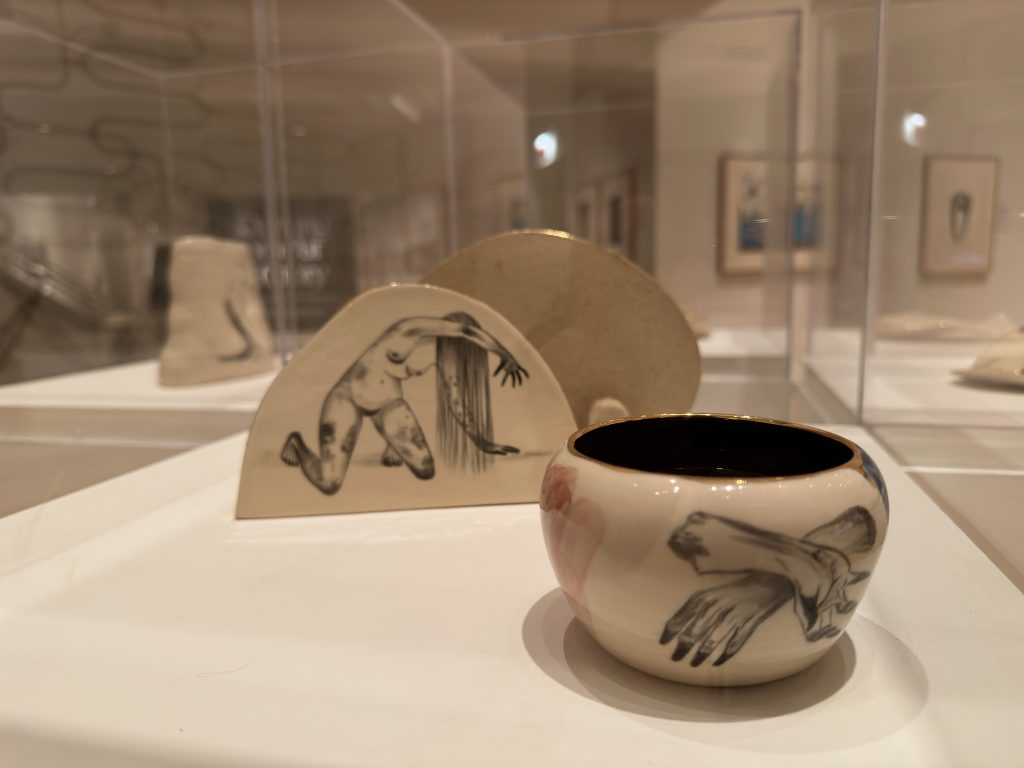
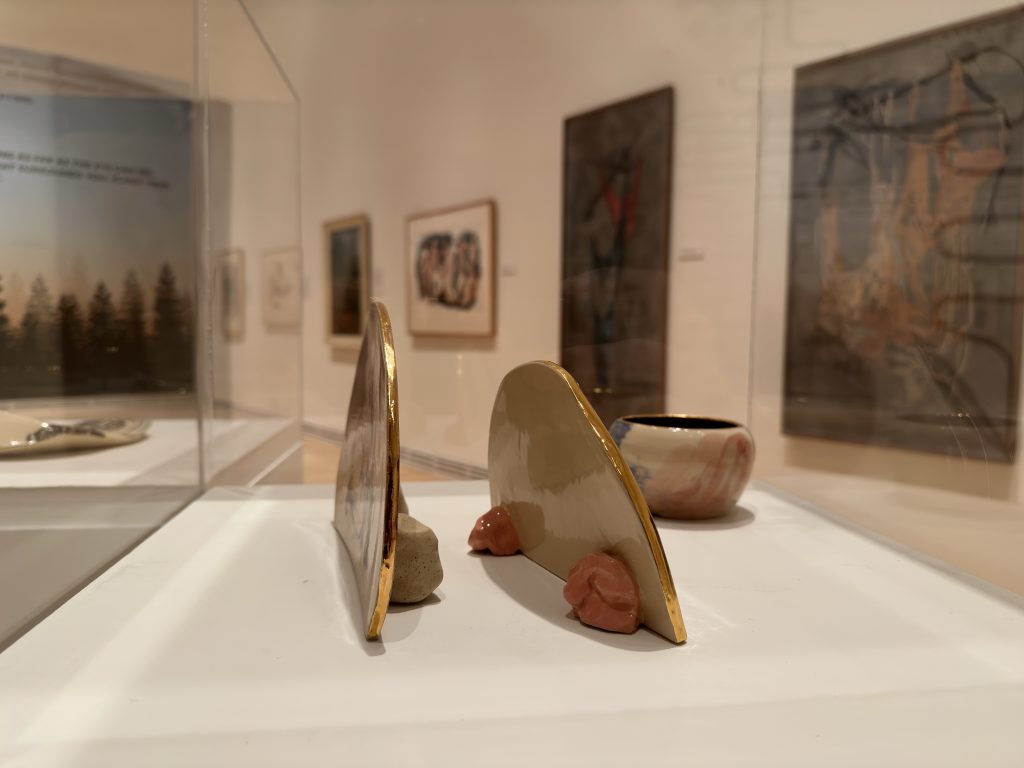
Marigold Santos
shroud (melting, kneeling) (2018)
shroud arm covering (2018)
memory feels 2 (2018)
Clay, glazes and 22k gold
Courtesy of the artist and Patel Brown
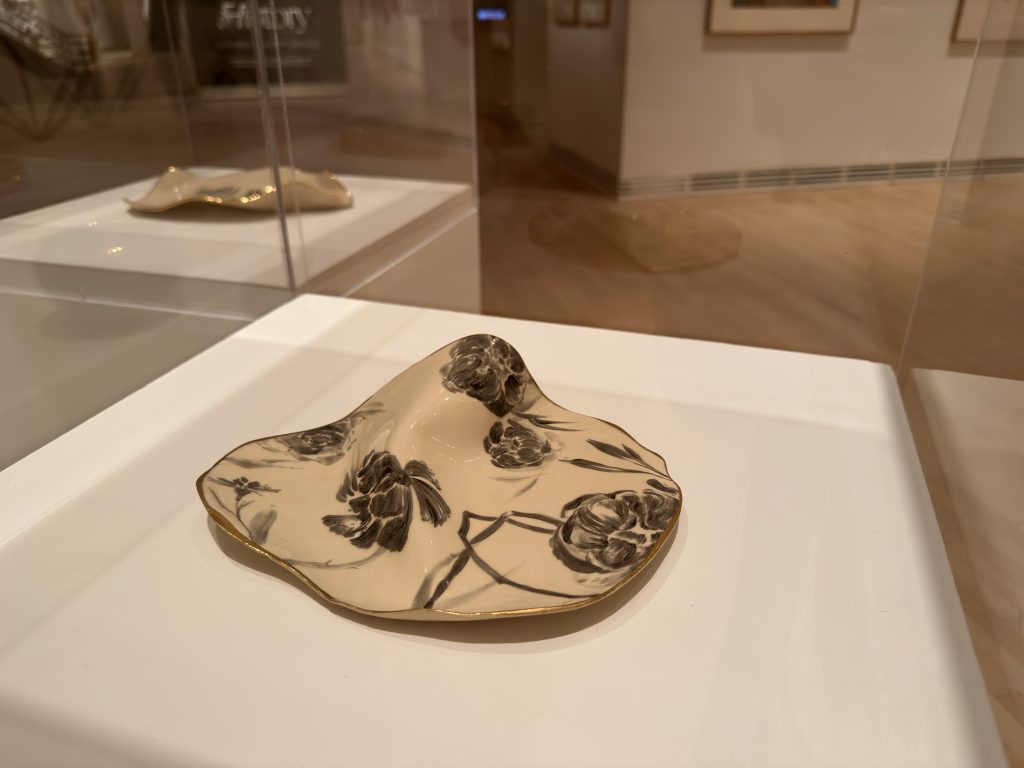
Marigold Santos
floral skin shroud 1 (2018)
Clay and glazes
Courtesy of the artist and Patel Brown
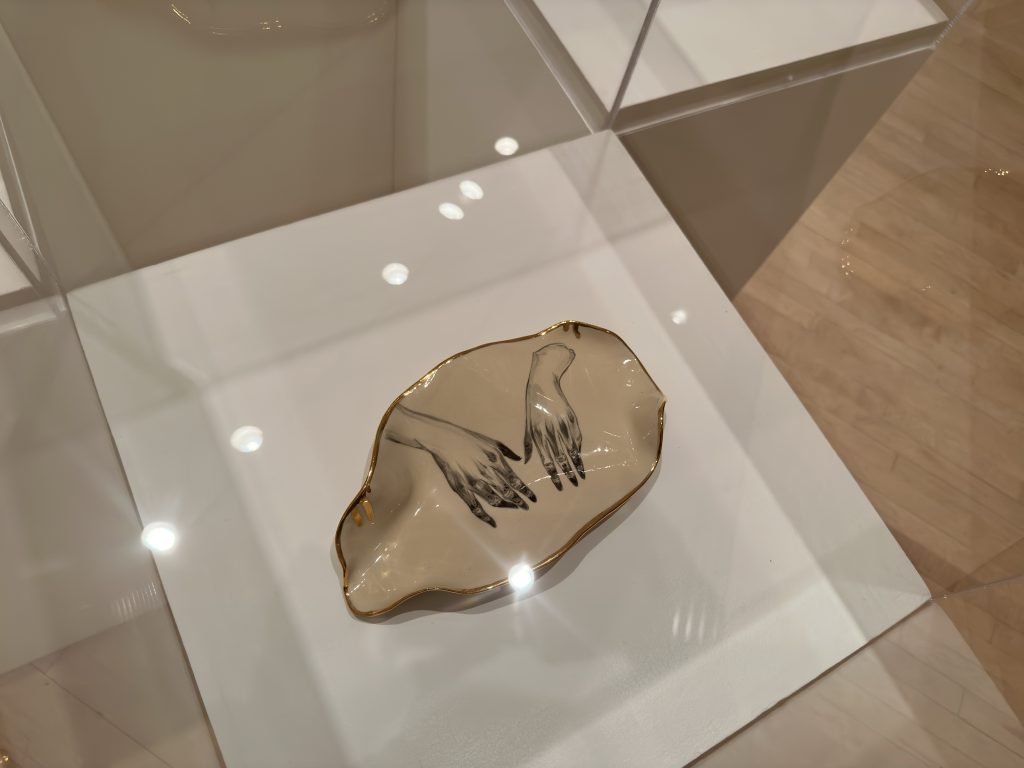
Marigold Santos
memory feel 1 (2018)
Clay, glazes and 22k gold
Courtesy of the artist and Patel Brown
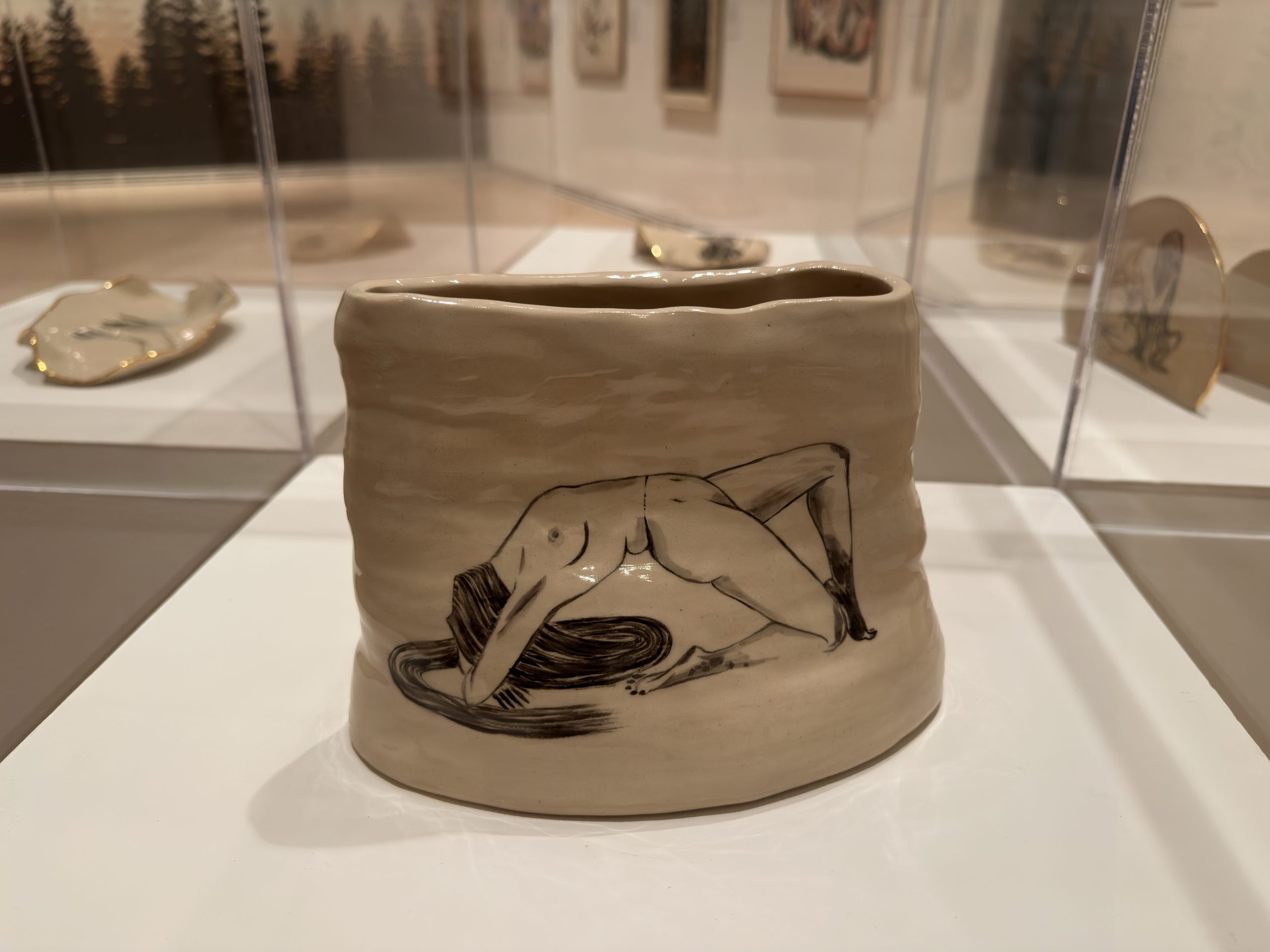
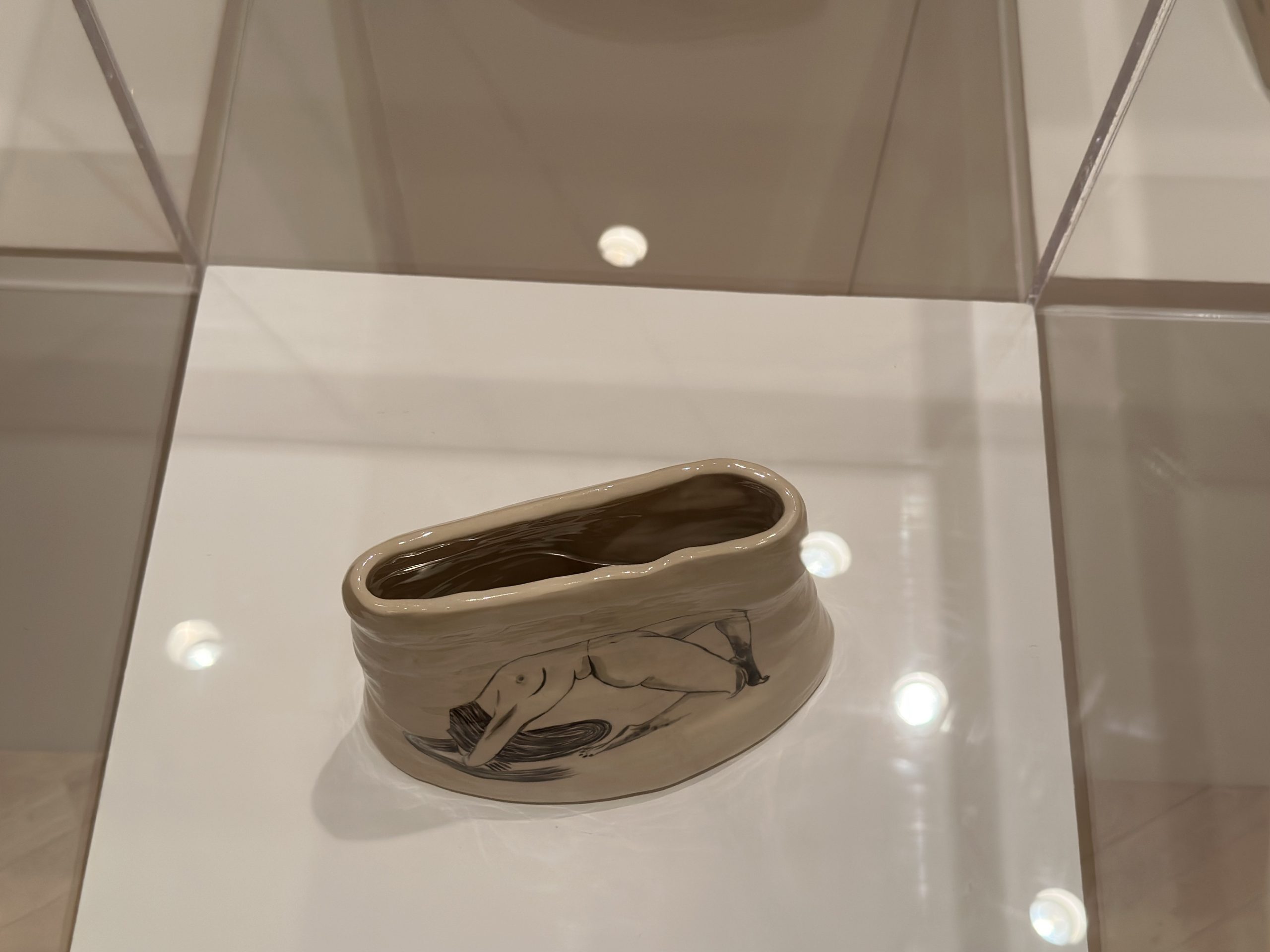
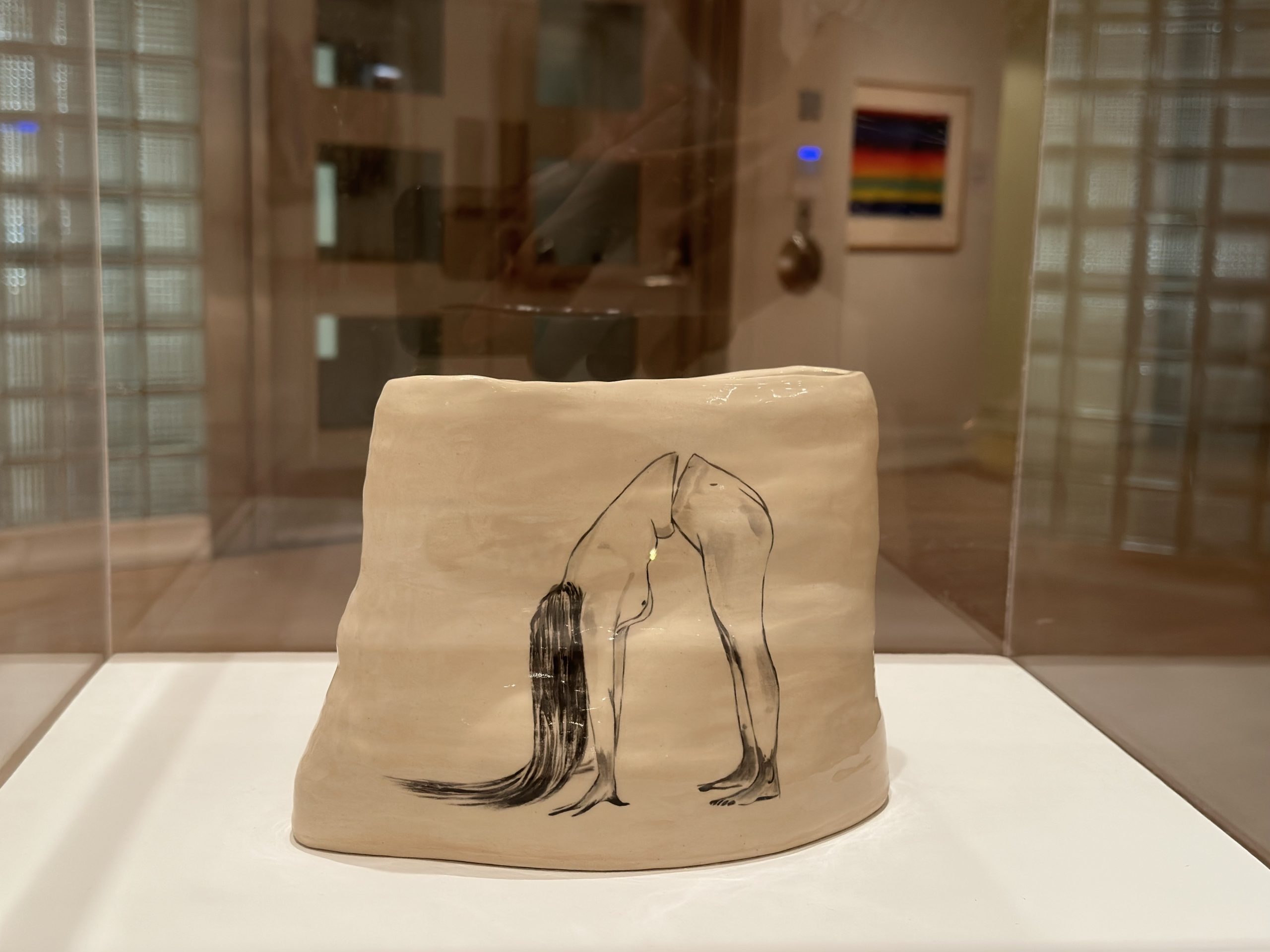
Marigold Santos
shroud asuang bridging (2019)
Clay and glazes
Courtesy of the artist and Patel Brown

Robert (Scottie) Wilson (Canadian, 1890-1972)
Vision of Mrs. Barwick in Scottie Jewelry (prior to 1972)
Ink and coloured pencil on paper
Gift of Jack and Frances Barwick, 1985
The Scottish-born Louis Freeman (a.k.a. Robert “Scottie” Wilson) arrived in Toronto in the early 1930s, where he owned a junk shop. His artistic career was launched by his felicitous find of a gold pen, with which he started drawing…Read More

Frederick H. Varley (Canadian, 1881-1969)
Frances E. Barwick (1952)
Black chalk on paper
Gift of Jack and Frances Barwick, 1985
Frederick Varley, of Group of Seven fame, moved to Toronto in 1944. His art dealer in the city was Douglas Duncan, brother of Frances Barwick and proprietor of the innovative Picture Loan Society. Barwick undoubtedly met Varley through…Read More

Rita Letendre (1928-2021)
Abenaki / Ouébécoise
Aujourd’hui l’écho de l’orage résonne (1982)
Pastel on paper
Gift of Rita Letendre, 1998
Winner of a Governor General’s Award in Visual and Media Arts in 2010, Rita Letendre began her exploration of abstraction in the 1950s working with Montreal’s Automatistes…Read More

Jessie Oonark (Qamani’tuaq, 1906-85)
Untitled (Two Totems) (1976)
Crayon and coloured pencil on paper
The Priscilla Tvler and Maree Brooks
Collection of Inuit Art
There is no textual explanation for this artwork

Lucy Qinnuayuak (Kinngait, 1915-82)
Birds Carry the Sun to Birdland (1977)
Crayon and felt-tip pen on paper
The Priscilla Tyler and Maree Brooks
Collection of Inuit Art
There is no textual explanation for this work

Florence Vale (Canadian, 1909-2003)
Nude and Kite (1973)
Mixed media on paper
Gift of the artist, 1994
Born into a family of musicians, Florence Vale began her creative journey on the piano before turning to the visual arts in the 1940s. Vale’s early experiments included oil and watercolour painting as well as rug hooking…Read More

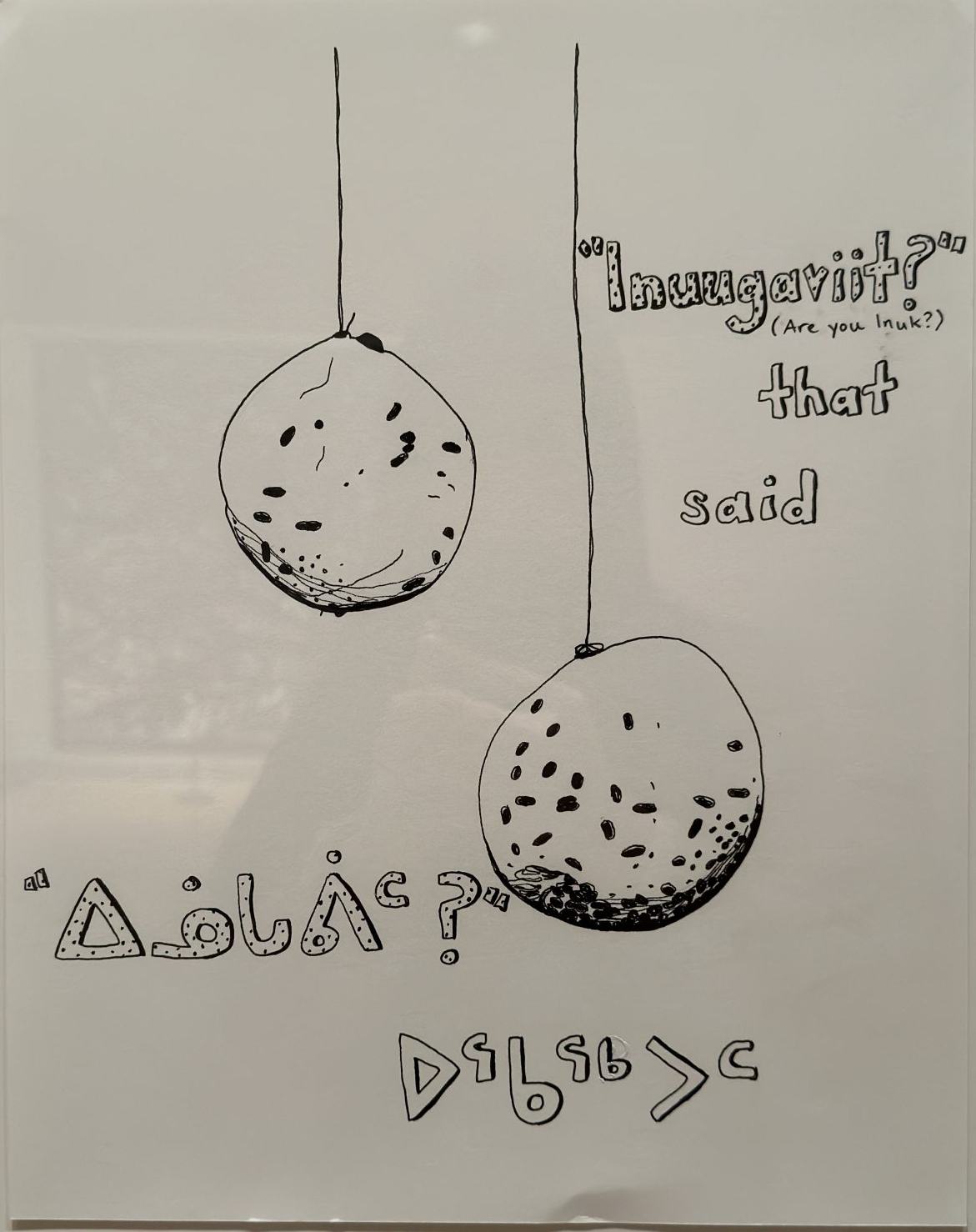


Gayle Uyagagi Kabloona
Invited by Sandra Dyck
You should be a part of us, 2023
Ink on paper
Courtesy of the artist
Sandra writes:
The groundbreaking American writer Audre Lorde famously described herself as “Black, lesbian, mother, warrior, poet.” Lorde reiected external definitions of her identity that singled out, or marginalized, any one of these categories. Her poetry, she said, “comes from the intersection of me and my worlds!”
These questions of the part and the whole, of identity and belonging, are central to the work that Gayle Uyagagi Kabloona made for Drawing on Our History. Born in Qamani’tuaq – or Baker, as she calls it – to an Inuk father and a white mother, Kabloona has long lived away from the community. All her life, as she writes on these drawings, she has been asked, “What are you?”
“Where do you belong?”
Kabloona belongs to making – to drawing, sewing, printmaking, knitting and building clay pots by hand. She belongs to the objects depicted in these drawings – sharp ulus with handles of wood or antler; a stone kudlik; a beaded sealskin marnguti that holds kudlik wicks; spherical ornaments made from ptarmigan gullets called puvviat – and to the creative acts that give rise to them. She belongs to her family tree, whose branches reach west to California and north to Inuit Nunangat.
Kabloona also belongs to the places she’s made home – Baker, Iqaluit, Ottawa. She belongs to the old stories she heard from her dad when she was a child. She belongs to the extraordinary legacy of visual culture inherited from Qamani’tuaq artists including Victoria Mamnguqsualuk (her grandmother), Jessie Oonark (her great-grandmother) and Luke Anguhadluq. Kabloona’s work comes from her intersection with all these worlds, and many more.

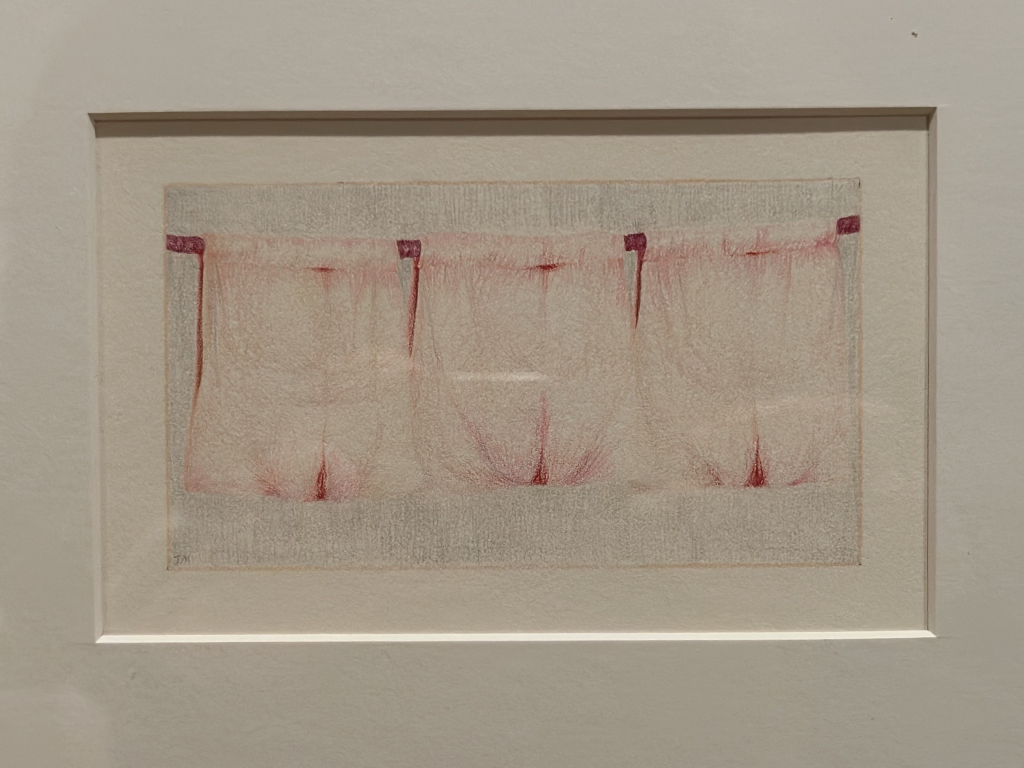
Jane Martin (Canadian, b. 1943)
Transfiguration 2 (1986)
Prismacolor on paper
Gift of Victoria Henry, 2000
Three Figures (1983)
Prismacolor on paper
Gift of Michel Christensen, 1994
These lane Martin drawings are emblematic of a new thread in the artist’s work, which emerged in the 1980s. Art historian Christine Conley writes of this period:
In the beginning there was drawing.. And the drawing began in 1983 at Martin’s cottage on Donaldson Lake, where sultry weather and the artist’s ongoing interest in the sensate body conspired with her first venture into Prismacolor, to produce a series of delicately rendered studies of the female body.
Read More

Ron Martin (Canadian, b. 1943)
Left Hand, Index Finger (1972)
Red ink on paper
Gift of Catherine Morrissey, 1995
In his 1970s paintings, Ron Martin set rigid parameters: a consistent canvas size, a limited amount of paint, one colour, uninterrupted working sessions and repetition via series…Read More

Chander Chopra (Canadian, b. 1944)
Untitled (1989)
Mixed media on paper
Gift of Pierre Luc St-Laurent, 2003
There is no textual explanation for this artwork

Betty Goodwin (Canadian, 1923-2008)
Untitled (1989)
Graphite, charcoal and ink on Mylar
Gift of Anne Thompson, 2008
Largely self-taught, the Montreal-born artist Betty Goodwin is internationally acclaimed for her distinctly emotive and corporeal drawing style. Her work has been widely exhibited, including representing Canada at the 1989 São Paulo…Read More

Takao Tanabe (Canadian, b. 1926)
Banff(1953)
Watercolour on paper
Gift of Arthur Drache, 2010
This dark, yet striking, watercolour by Takao Tanabe could be interpreted in many ways: as a prairie landscape, as a foreshadowing of his exploration with Japanese calligraphy and / or as an allegory for the time that he and his family…Read More

Kazuo Nakamura (Canadian, 1926-2002)
Summer Landscape (1954)
Watercolour on paper
Gift of Glenn and Barbara Mclnnes, 1994
A founding member of the 1950s Toronto collective Painters Eleven, Kazuo Nakamura created artworks inspired by the New York abstract expressionist movement, as well as more figurative works. Nakamura viewed abstraction as a means…Read More

John Ensor (Canadian, 1905-95)
Floating Docks, Normandy Invasion (1944)
Watercolour on paper
Gift of Robert Armstrong in memory of Francine Parisien (1939-1985), 1994
John Ensor studied mural painting in England before immigrating to British Columbia in 1939. Working in watercolour in a loosely rendered, emotive style, he attempted to document. Read More

David Milne (Canadian, 1882-1953)
Points and Islands No. 2 (1950)
Watercolour on paper
Gift of the Douglas M. Duncan Collection, 1970
There is no textual explanation for this artwork

Norval Morrisseau (1931-2007)
Bingwi Neyaashi Anishinaabek (Sand Point First Nation)
The Mihshipashoo (1978)
Graphite on paper Gift of Robert Houle, 2001
This drawing is a vestige of a famous tea party hosted by Anishinaabe artist Norval Morrisseau at his home in Beardmore, Ontario, in the summer of 1978. Jack Pollock, Morrisseau’s Toronto-based art dealer…Read More


Ron Giii (Canadian, b. 1944)
Untitled, Wipe Works No. 29 (prior to 1995)
Untitled, Wipe Works No. 19 (prior to 1995)
Ink and graphite on paper
Gift of Jeffrey Lipson, 1995
Originally a performance artist and theatre director in New York before switching his focus to drawing in the mid-1980s,Ron Gill views his artistic creation as a sort of visual theatre…Read More

Kananginak Pootoogook (Kinngait, 1935-2010)
Man with Snowmobile (2006)
Coloured pencil and ink on paper Purchase, 2012
The Inuktitut syllabics read, in English: When the snowmobile first came up north, everyone thought they were mighty machines compared to a dog team. In this case it isn’t, the dog team is more reliable than the snowmobile…Read More

Bob Boyer (Metis, 1948-2004)
Plans for Tee-pee at the First Native Business Summit (1986)
Ink and watercolour on paper
Gift of Robert Houle, 2001
Bob Boyer was a renowned Métis artist, art historian, curator and educator who exhibited his work across Canada and internationally. Working across sectors in education…Read More


Claude Tousignant (Canadian, b. 1932)
Ink on card (1995)
Clockwise from lower left:
Dessin a l’encre diluée
Gift of Mark Busgang, 1996
Dessin a l’encre
Gift of Reginald Pearson, 1996
Dessin a l’encre diluée
Gift of Mark Busgang, 1996
Dessin a l’encre
Gift of Elke Dinter, 1995
Dessin a l’encre
Gift of Elke Dinter, 1996
Dessin a l’encre
Gift of Elke Dinter, 1996
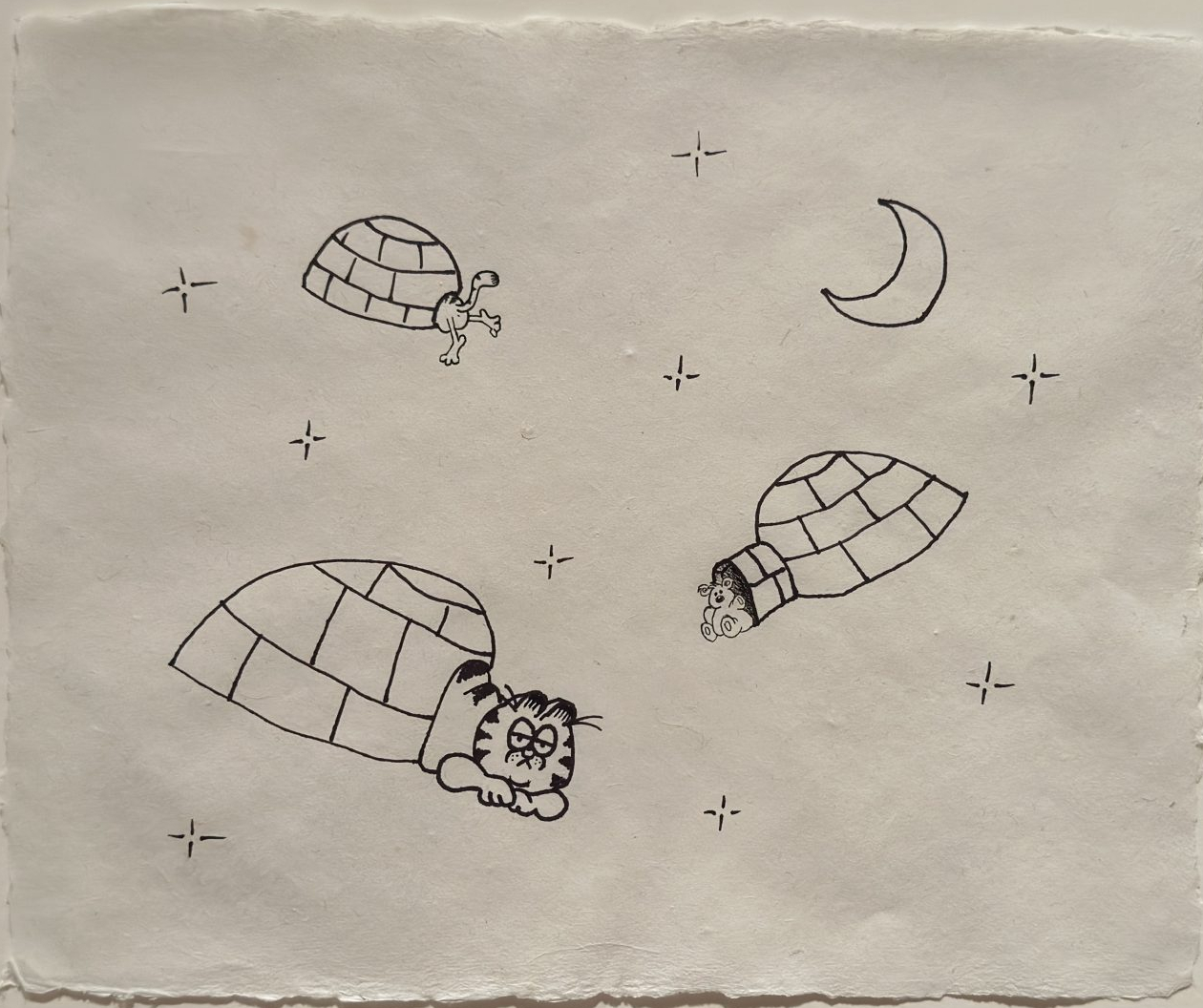
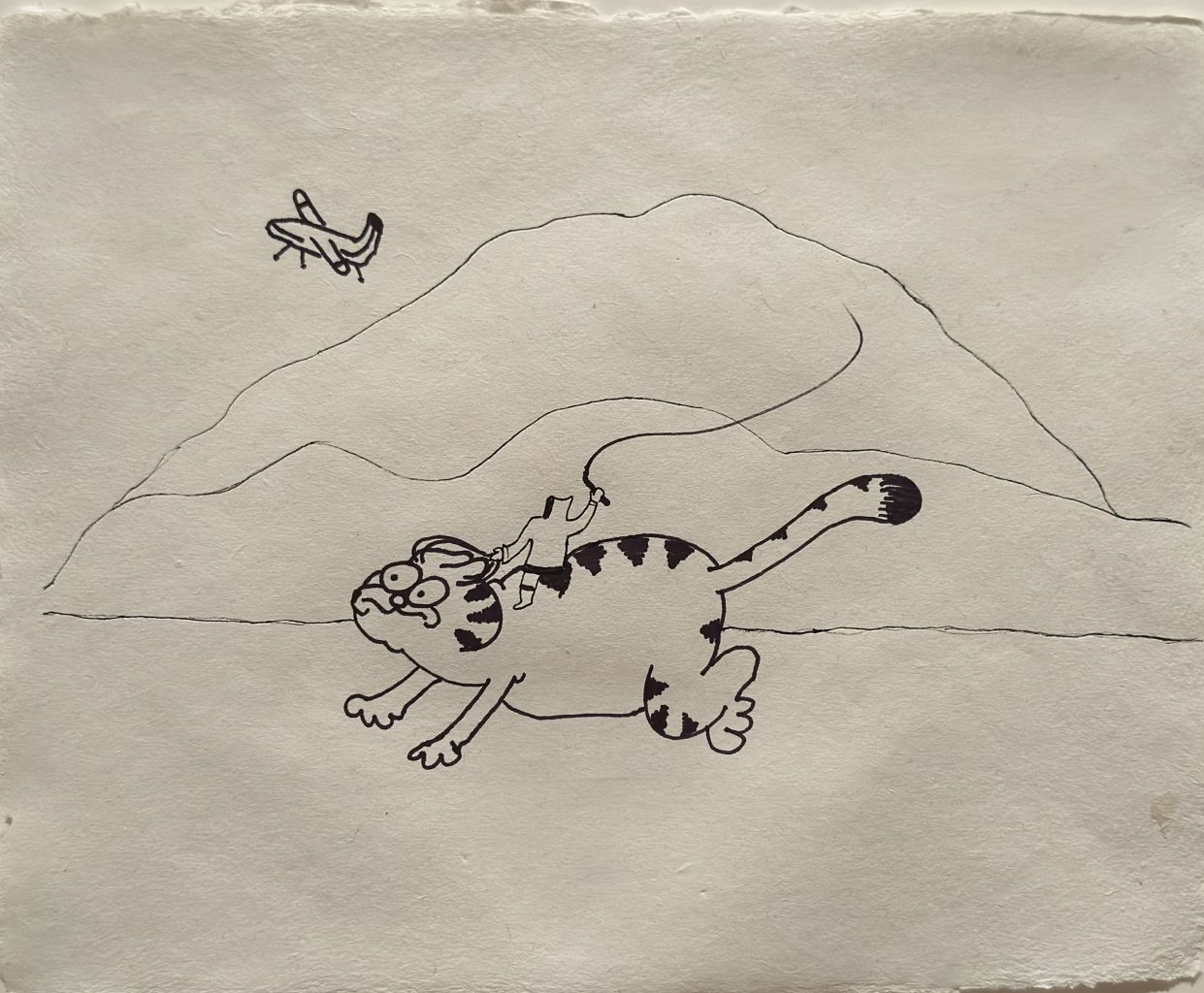
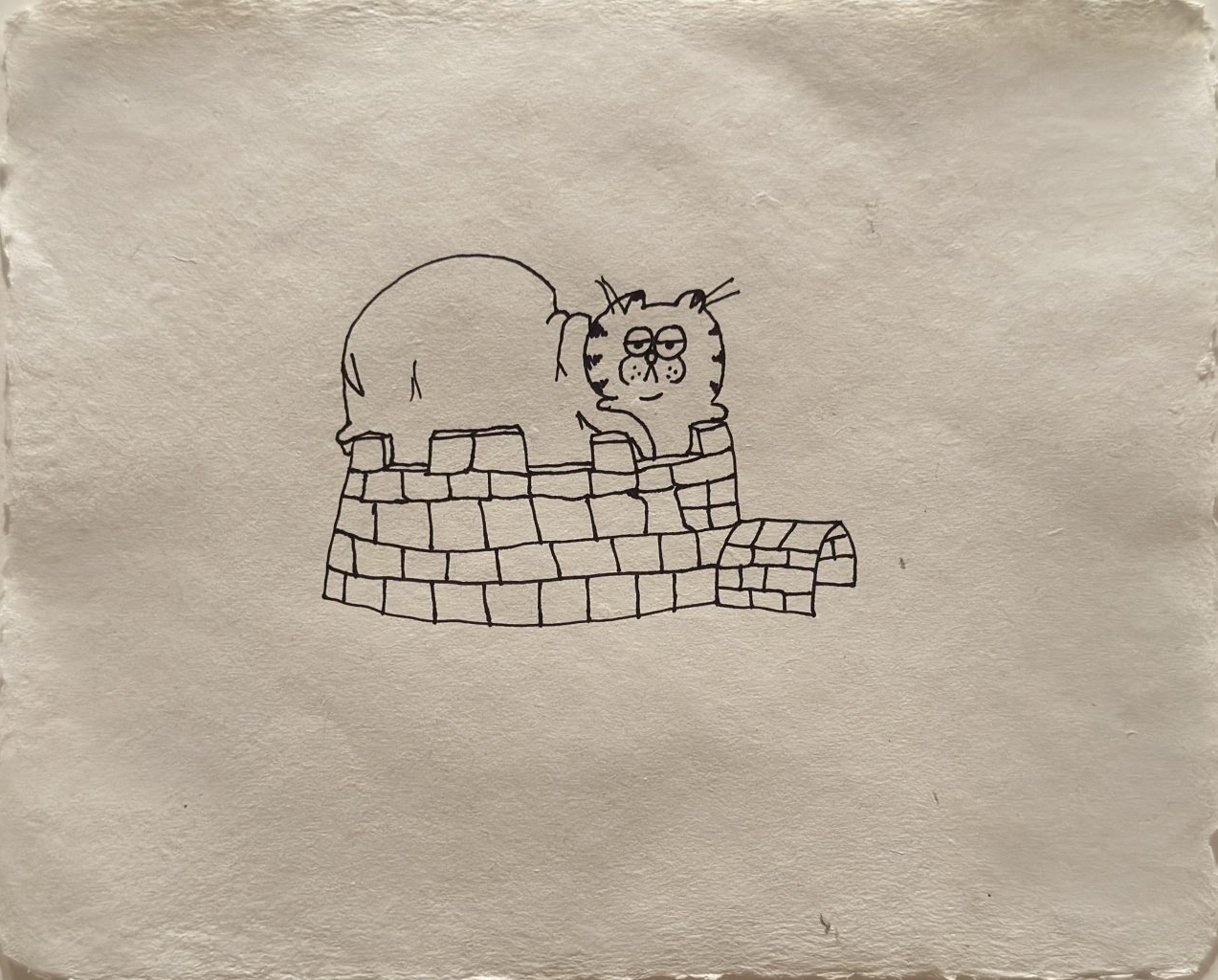
Kablusiak
Invited by Heather Igloliorte
Garfields and Pooky (inspired by Germaine Arnaktauyok’s “Innua” 2007) (2021)
An Inuk Riding Garfield (Inspired by Pudlo Pudlat’s “Vision of Two Worlds” 1983 (2021)
Garfield Sitting in an Iglu (inspired by Agnes Topiak’s “Sleeping Family” 1970) (2021)
Ink on paper, edition 1/3
Courtesy of the artist and Norberg Hall
Heather writes:
The Inuvialuk artist Kablusiak draws on Inuit art history and personal experiences in their artwork, which includes drawing, carving and sewing – canonical practices within the modern Inuit art industry beginning in the mid-twentieth century.
Years ago, Kablusiak gave an interview in which they talked about the “crushing weight of Inuit art” – that heavy, heady, imposing history of markets and masterworks that still looms large over Inuit art production. White settler outsiders established the international art market, dictating what could and could not be defined as Inuit art. There were also so many unbelievably brilliant Inuit artists in those early years whose prolific and raw talent defined Inuit aesthetics for generations.
These inherited legacies can inspire, but also intimidate, emerging artists: Kablusiak found them almost overwhelming when in art school. They started making loose, cathartic sketches as a way to free themself from the burden of cultural representation.
Lucky for us, they no longer feel the extraordinary weight of Inuit art history. Today, Kablusiak engages with that legacy freely, whether by adding Garfield to an iconic Germaine Arnaktauyok print or one-upping Annie Pootoogook’s Watching Jerry Springer (2002-03) with an even more scandalous parody of an earlv-2000s viral video.
As Kablusiak has said, “I am at a point in my artmaking where I have permission from myself – and other people – and now I can just have fun.” Now, Inuit art history, for Kablusiak, is “more like a weighted blanket.”

Kablusiak
Two girls one computer (2022)
Pencil cravon and ink on paper
Courtesy of the artist and Norberg Hall
There is no textual explanation for this artwork

Kablusiak
Selection from the Life Is Okay Sometimes series (2014-17)
Ink on paper
Courtesy of the artist and Norberg Hall
There is no textual explanation for this artwork

Kablusiak
That’s All! (2022)
Pencil crayon and ink on paper
Courtesy of the artist and Norberg Hall
There is no textual explanation for this artwork
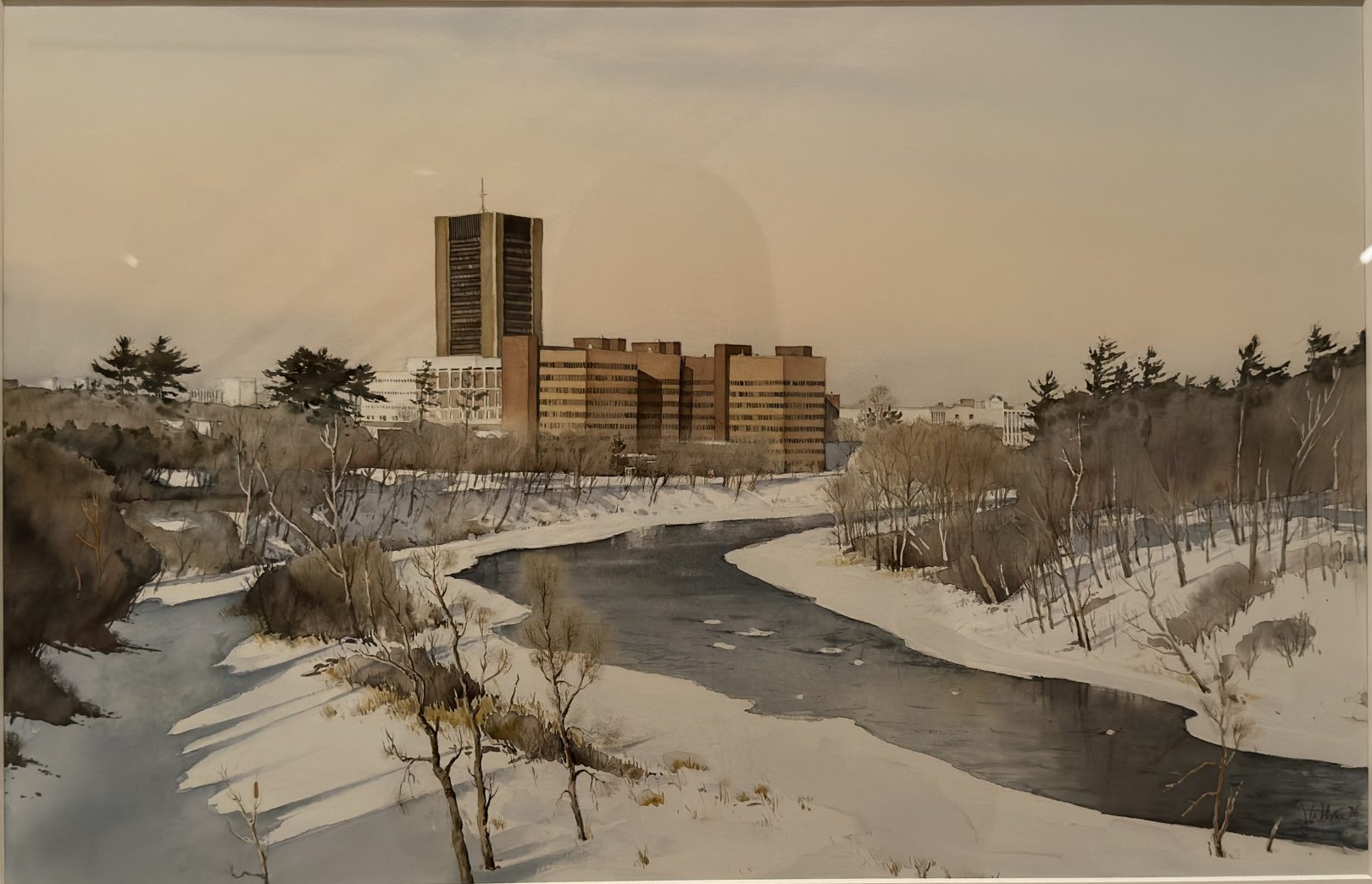
John Webster (Canadian, b. 1947)
Carleton University, Ottawa (1986)
Watercolour on paper
Gift of Helen and Courtney Gilliatt, 1987
There is no textual explanation for this artwork

Elizabeth Harrison (Canadian, 1907-2001)
Carleton College Crest and Motto (1951)
Pen and ink on paperCarleton University Corporate Records and Archives
In 1951, Carleton University’s Board of Governors commissioned the Kingston-based artist Elizabeth Harrison to render the University’s proposed crest…Read More

Richard H. Millson (1886-1946)
New Building for the Ottawa Ladies College (1913)
Graphite and watercolour on paper
Carleton University
We found this uncatalogued drawing while looking through the collection in preparation for Drawing on Our History. This architectural rendering, made by architect Richard H. Millson, depicts the former Ottawa Ladies College, which…Read More

Kim Moodie (Canadian, b. 1951)
Untitled (undated)
Felt-tip pen on paper
Gift of Mary-Anne de Kergommeaux, 1997
Kim Moodie is known for his highly detailed ink drawings. Mining and mixing historical traditions and cultural genres from illuminated manuscripts to comic books, graphic novels and children’s books, Moodie has developed…Read More

Shelagh Keeley (Canadian, b. 1954)
Ex Voto / Lung (1990)
Graphite, wax, charcoal and pigment on Transpagra
Gift of Ron Kaplansky, 1995
After graduating from York University in Toronto in 1977, Shelagh Keeley spent the next two decades between New York and Paris, creating the large-scale drawings and installation works for which she is acclaimed…Read More

Luke Anguhadluq (Qamani’tuaq, 1895-1982)
Drum Dance (1972)
Coloured pencil on paper
Gift of Drew and Carolle Anne Armour, 2009
An esteemed hunter and leader, Luke Anguhadluq moved to Qamani’tuaq in 1961. His first documented drawings, made that year, no longer survive, but he was soon drawing regularly. He sometimes turned the paper…Read More
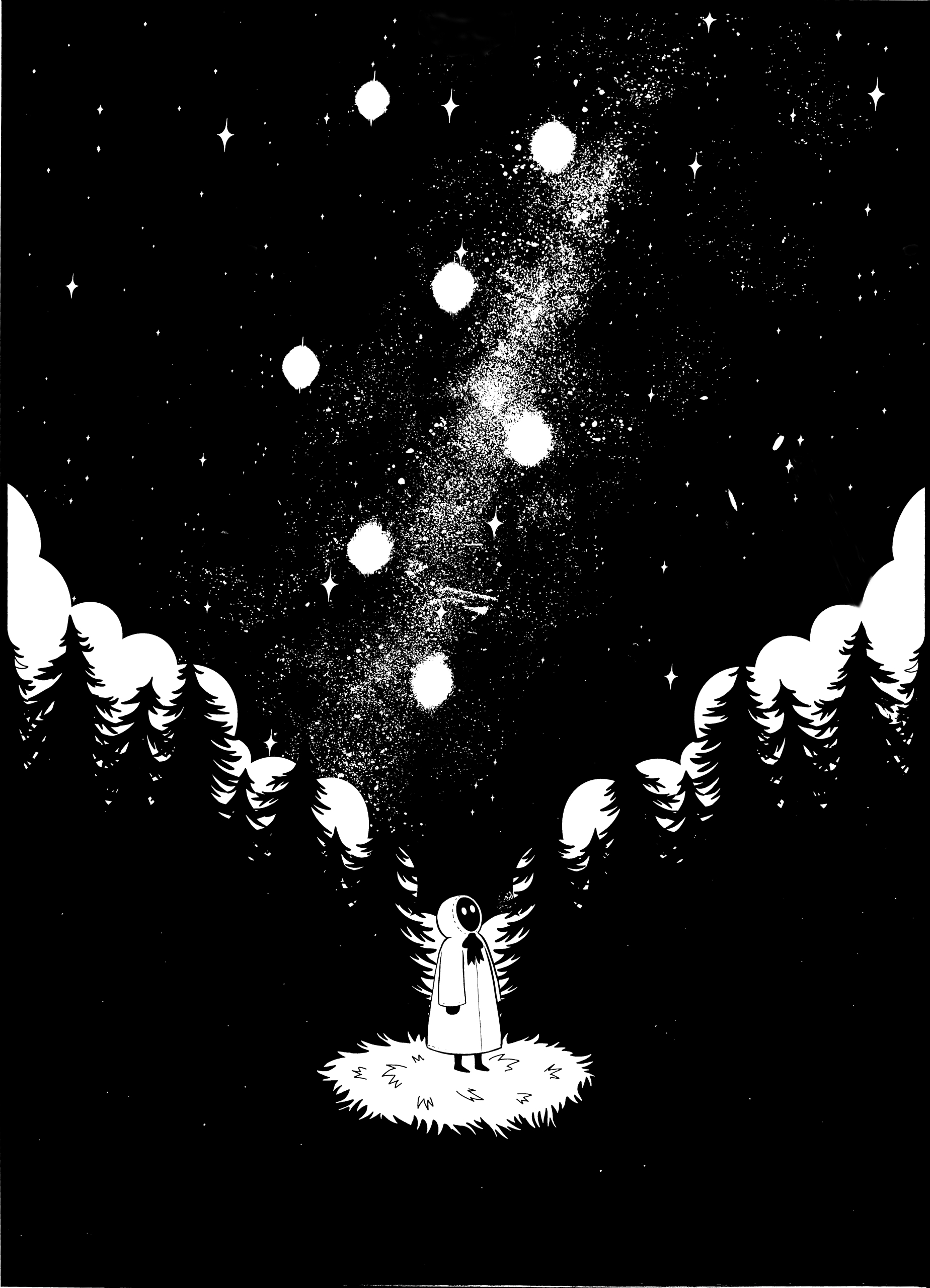
When the Stars Speak
By Nalakwsis
It was getting chilly. Soup could feel it in the wind and feel the messages it carried.
The wind told Soup the cold would stay soon. The sun had set long ago and in the clear night sky, the Stars were twinkling. Soup could smell the frost in the air and see it in the Stars.
It felt lonely. A feeling Soup didn’t feel often, but when they did, it felt exactly how it feels when the cold stays and the nights become longer. When the animals sleep, and the air is frozen. It was lonely. Taking in the air, Soup closed their eyes.
A soft voice reached out suddenly. “Hello, little one.” It said.
Soup opened their eyes and looked around. “Hello?” Soup answered.
“Up here!” Two voices spoke this time. And then three voices directed, “Up here, our relative!”
“Oh, it’s you!” Soup responded and looked up at the Stars.
“Why do you feel so lonely?” The Stars asked together.
Soup thought for a moment and then answered, “It just feels… lonely at this time. The animals sleep, the trees sleep. The winds are busy. It’s just a lonely time for a being like me.”
“Our dear Little One. You are never alone! After all, you came from us.” The Stars sang together.
“Hmmm.. I guess I just always thought I couldn’t speak with you.” Soup said.
“We are always listening. And we always answer. Just take a moment and listen for us.” The Stars sang and danced.
“Oh! Well, would you like to hear what I did today?” Soup asked excitedly.
“Oh, yes please. The Stars giggled, their light shining brighter.
During the next long cold snowy nights, Soup found comfort and conversation in the Stars. Soup told the Stars of their many adventures. Even when the cold left, Soup looked to the Stars.
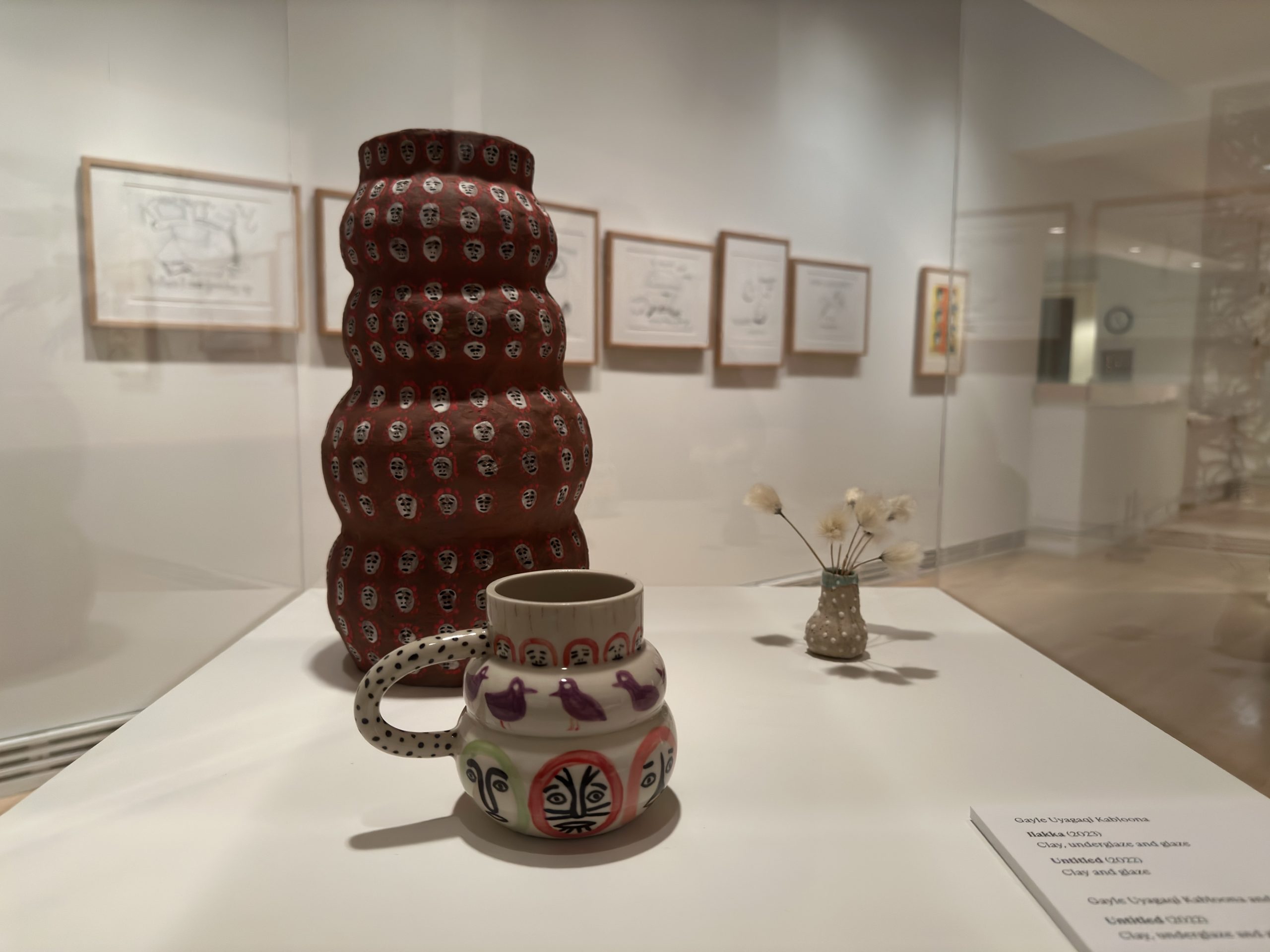
Gayle Uyagagi Kabloona
Ilakka (2023)
Clay, underglaze and glaze
Untitled (2022)
Clay and glaze
Gayle Uyagaqi Kabloona and Tracy Hurren
Untitled (2022)
Clay, underglaze and glaze
Courtesy of the artist
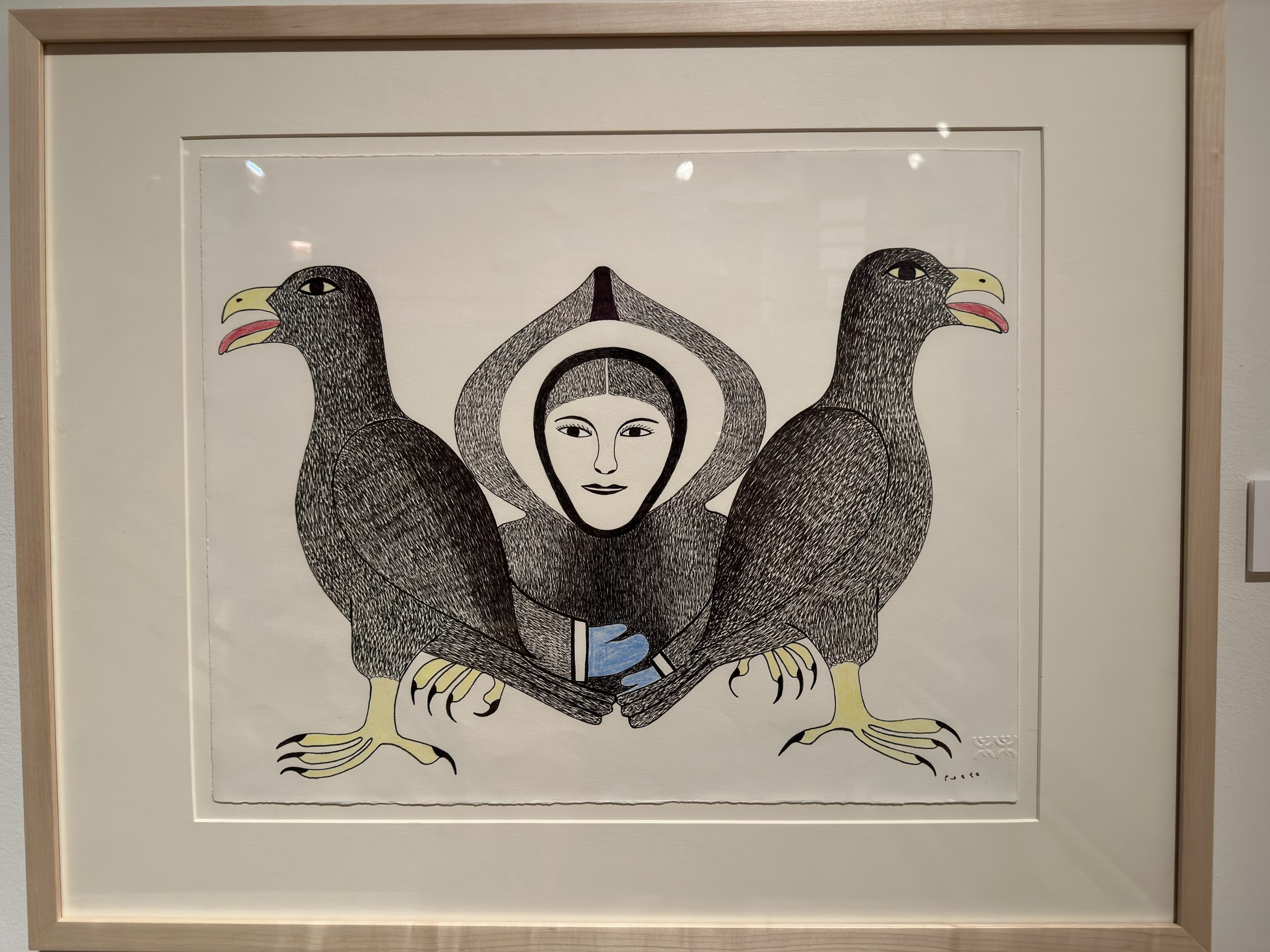
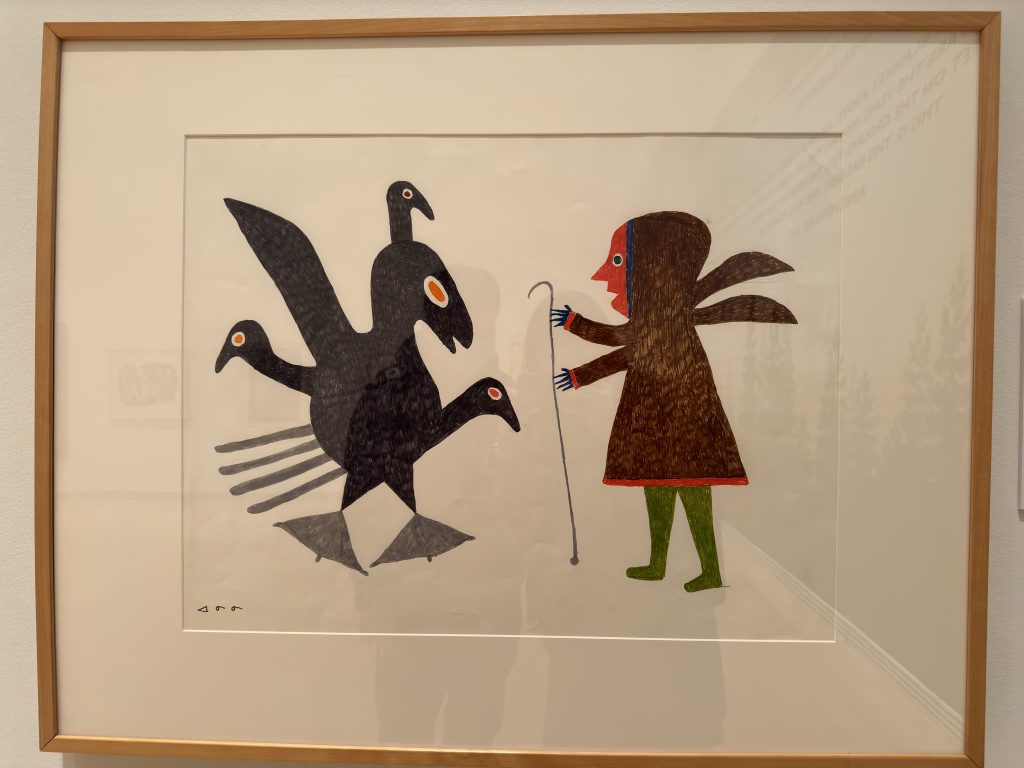
Kenojuak Ashevak (Kinngait, 1927-2013)
Untitled (Woman with Two Ravens) (undated)
Pen, coloured pencil and ink on paper The Priscilla Tyler and Maree Brooks Collection of Inuit Art
There is no textual explanation for this artwork
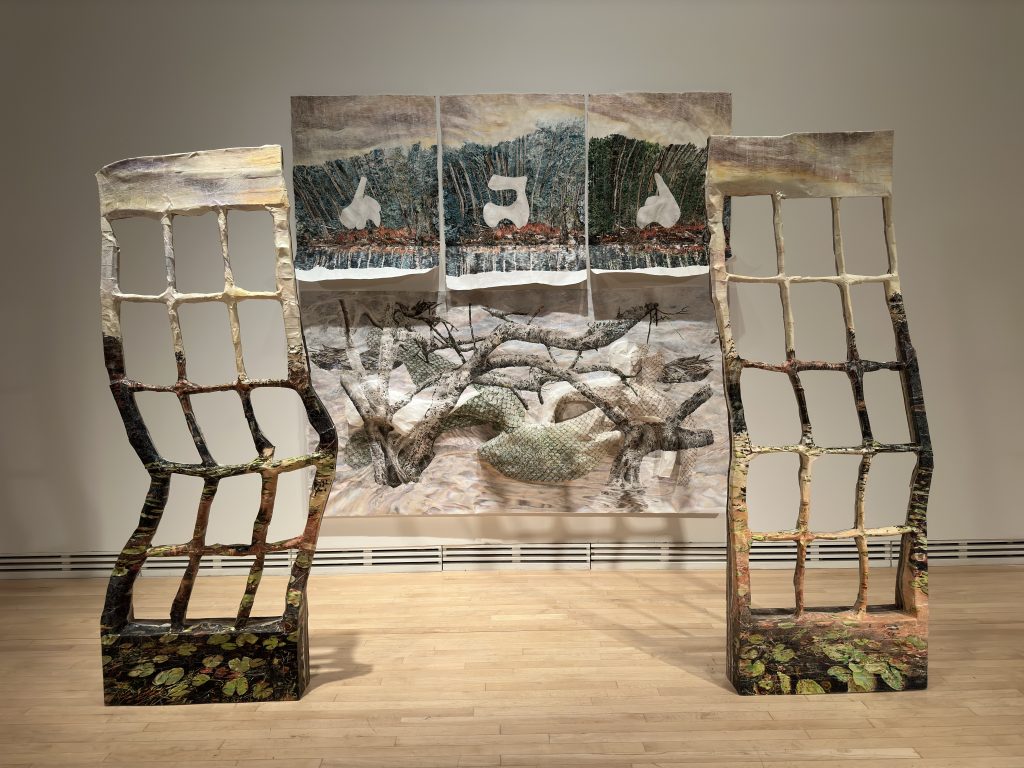
Mélanie Myers
Invited by Heather Anderson
Heather writes:
Mélanie Mvers explores the genres of landscape and land art as mediated by photographs, drawing from the seemingly unlimited V image bank available on the Internet. Myers leverages drawing and papier-mâché as a practical and economical way of engaging with monumental sculptures sited in the landscape, extending an earlier theme of her work in which she examined touchstone works of land art by Richard Serra and Michael Heizer among others.
In this new installation, the Gatineau-based artist depicts a rugged Canadian forest landscape as though seen from the water. In the upper triptych, white “negative space” forms inhabit the shoreline amidst stumps, branches and a dense screen of coniferous trees. These ghost-like shapes reference British artist Henry Moore’s Three Piece Sculpture: Vertebrae (1968-69). In the drawing below, another enigmatic form, this one inspired by Moore’s Large Reclining Ficure (1984) and patterned with delicate green scales, rests entwined with sprawling branches.
Building up the underlying surface with papier-mâché and sculpting freestanding elements, Myers pushes the forms and possibilities of drawing. Two French-style doors, structurally distorted like images reflected on rippling water, serve as the foreground. Like the detailed wall drawings, the doors’ pencil-crayoned surfaces evidence the labour of their creation. Their alluring camouflage effect invites us to come closer, while their windows become frames through which to view the multi-dimensional landscape beyond.
Sans titre (Henry Moore, Reclining Figure et Vertebrae), 2022-23
Coloured pencil on papier-mâché
With the assistance of Geneviève L Richard
Courtesy of the artist

Ed Pien (Canadian, b. 1958)
Medusa (2012)
Ink on cut 3M reflector film laminated on Shoji paper
The A. T. Tolley Art Collection
Ed Pien drew with a knife to create this shimmering tentacular composition. In 2004, Pien made a research trip to China, where he encountered a spectacular cut-paper piece in a temple. He began experimenting with the ancient Chinese art of papercutting. The monumental tree, human figures and ropes in Medusa reference La vendaison
(1633), an etching by Jacques Callot, and Nancy Spero’s sculpture Maypole: Take No Prisoners (2008). It is also inspired by Pien’s experience of fireflies amongst ancient trees: a captivating homage to trees as more-than-human beings…Read More
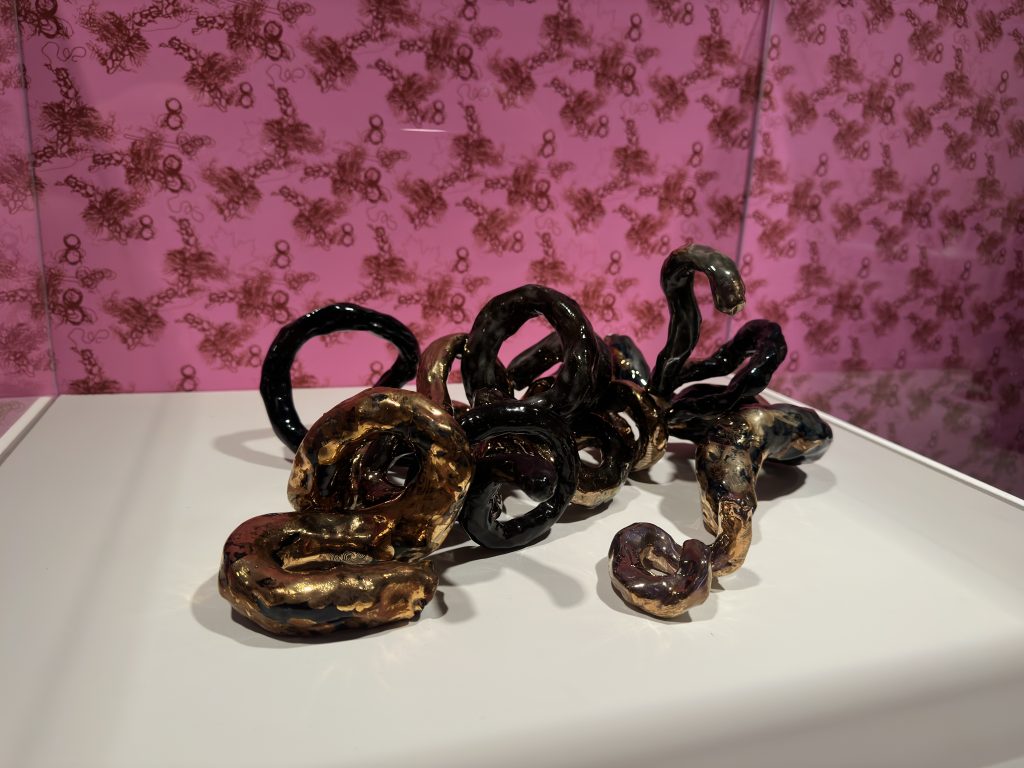
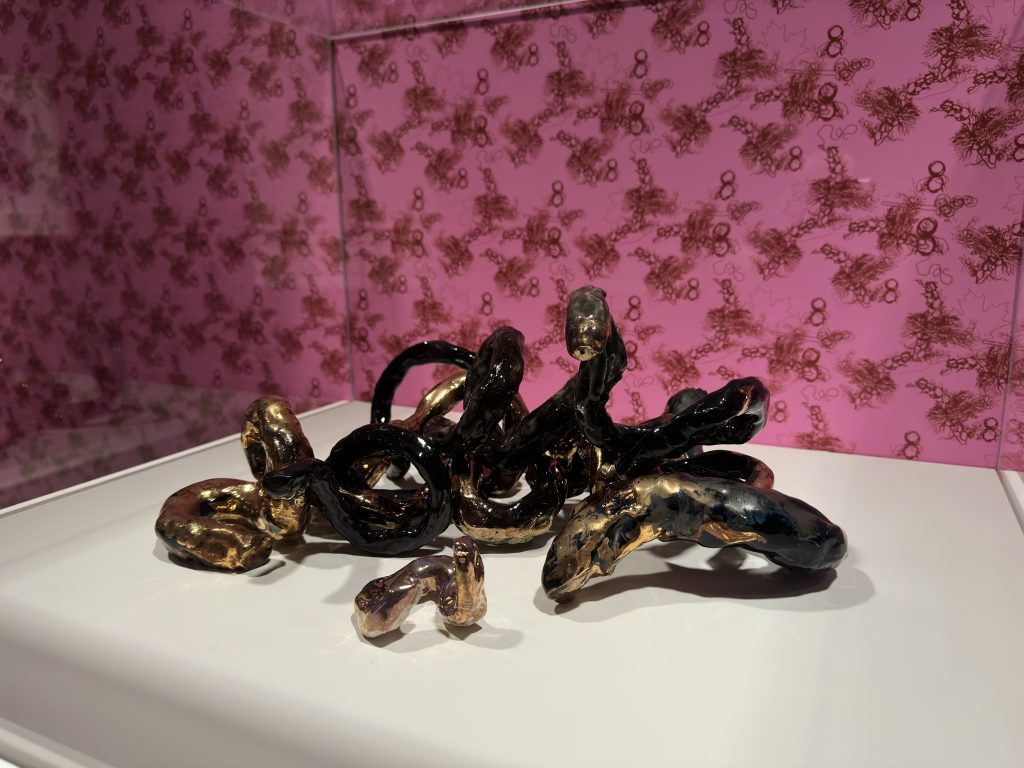
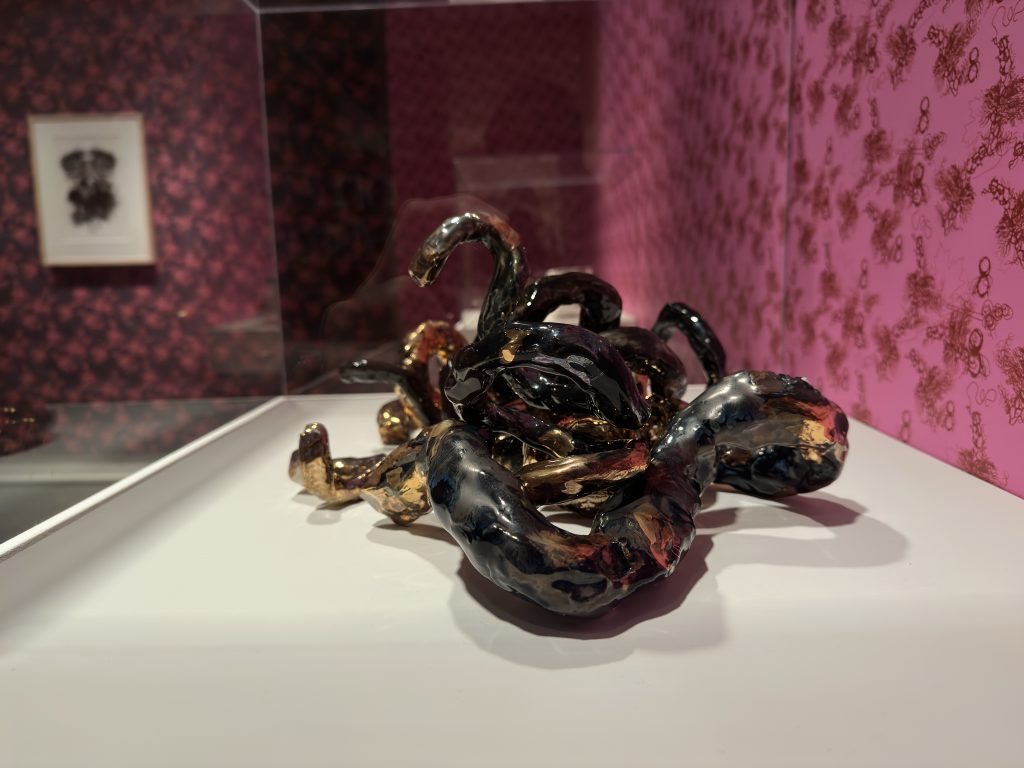
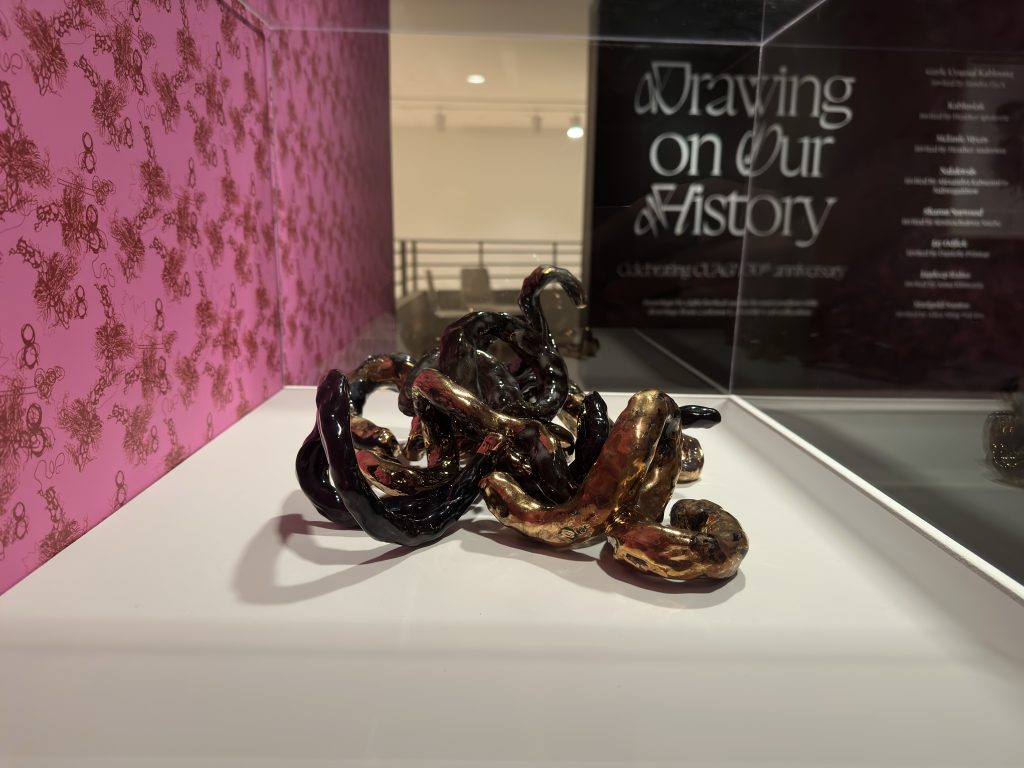
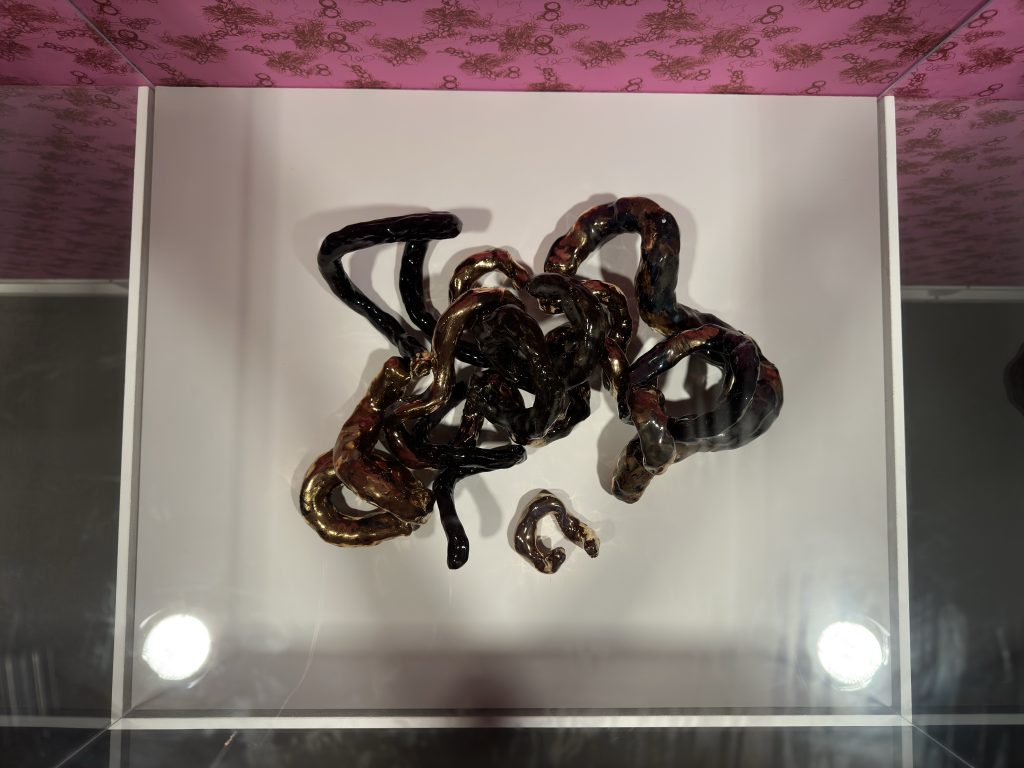
Sharon Norwood
Untitled (2018)
Glazed ceramic
Courtesy of the artist
Deliberately Peculiar (2022)
Glazed ceramic, overglaze, lustre and decals
Courtesy of the artist and The Next Contemporary
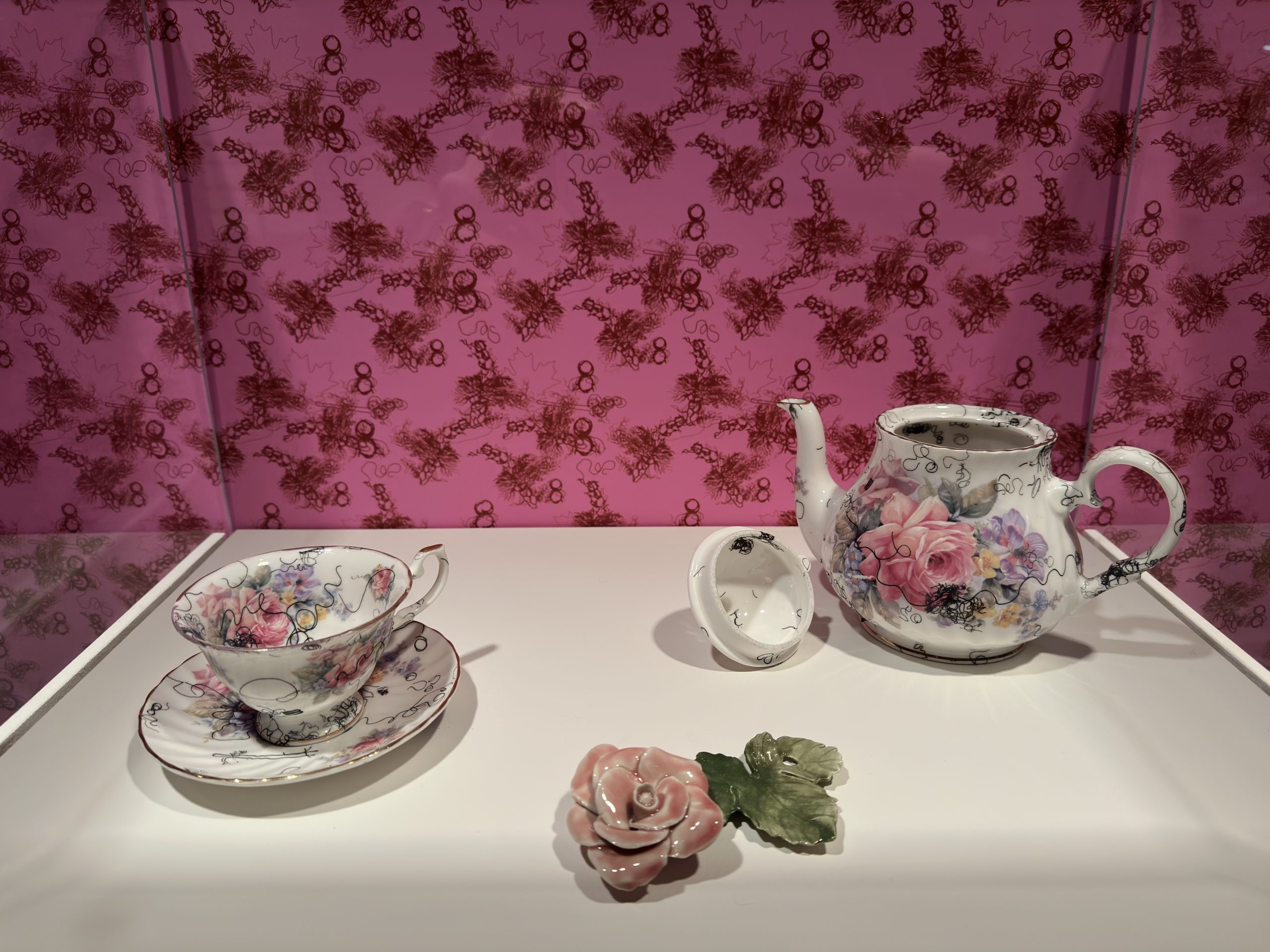
Hair Matters (2022)
Custom decal drawings on vintage porcelain tea set
Courtesy of the artist

The Root of the Matter (2016)
Digital collage on paper
Courtesy of the artist
Untangled Roots and Things (2023)
Custom wallpaper installation
Courtesy of the artist
Sharon Norwood
Invited by Kosisochukwu Nnebe
Kosisochukwu writes:
Rooted in the formal language of drawing and mark-making, Sharon Norwood’s practice homes in on a single line – a fine stroke reminiscent of the curl pattern of Black hair – to speak to complexities surrounding Black presence and history in North America.
Norwood’s commitment to rethinking both history and perceptions of beauty and Blackness is clear. In Hair Matters, the curly line adds itself to the delicate and ornate floral patterns of a porcelain tea set, whereas in The Root of the Matter, a digital collage, it comes to dominate imagery of three upper-class women sourced from a nineteenth-century European print in the Metropolitan Museum of Art’s collection. In both cases, the juxtaposition makes visible the relationship between race, gender, beauty, class and labour. The tea and new fashions that became symbols of class privilege from the fifteenth through the nineteenth centuries all depended on the production of sugar and cotton by enslaved Africans.
In Norwood’s practice, the line becomes a stand-in for the Black body; through the repeated drawing and superimposition of a single, curly line, she affirms the historic and continued presence of Black people in Canada. For Drawing on our History, this line expands even further, taking over the walls of the gallery in a site-specific wallpaper installation that goes beyond the decorative to become its own kind of map – a remaking of the Canadian landscape. And, finally, presented as a set of ceramic sculptures, the line takes on a physical form that visualizes the true heft and weight of its presence.

Jagdeep Raina
From where goodness grows (2014)
Mixed media on paper
Courtesy of the artist and Cooper Cole, Toronto
There is no textual explanation for this artwork

Jagdeep Raina
Moving target (2015)
Mixed media on paper
Courtesy of the artist and Cooper Cole, Toronto
There is no textual explanation for this artwork

Jagdeep Raina
this blessed house (2014)
Mixed media on paper
Courtesy of the artist and Cooper Cole, Toronto
There is no textual explanation for this artwork
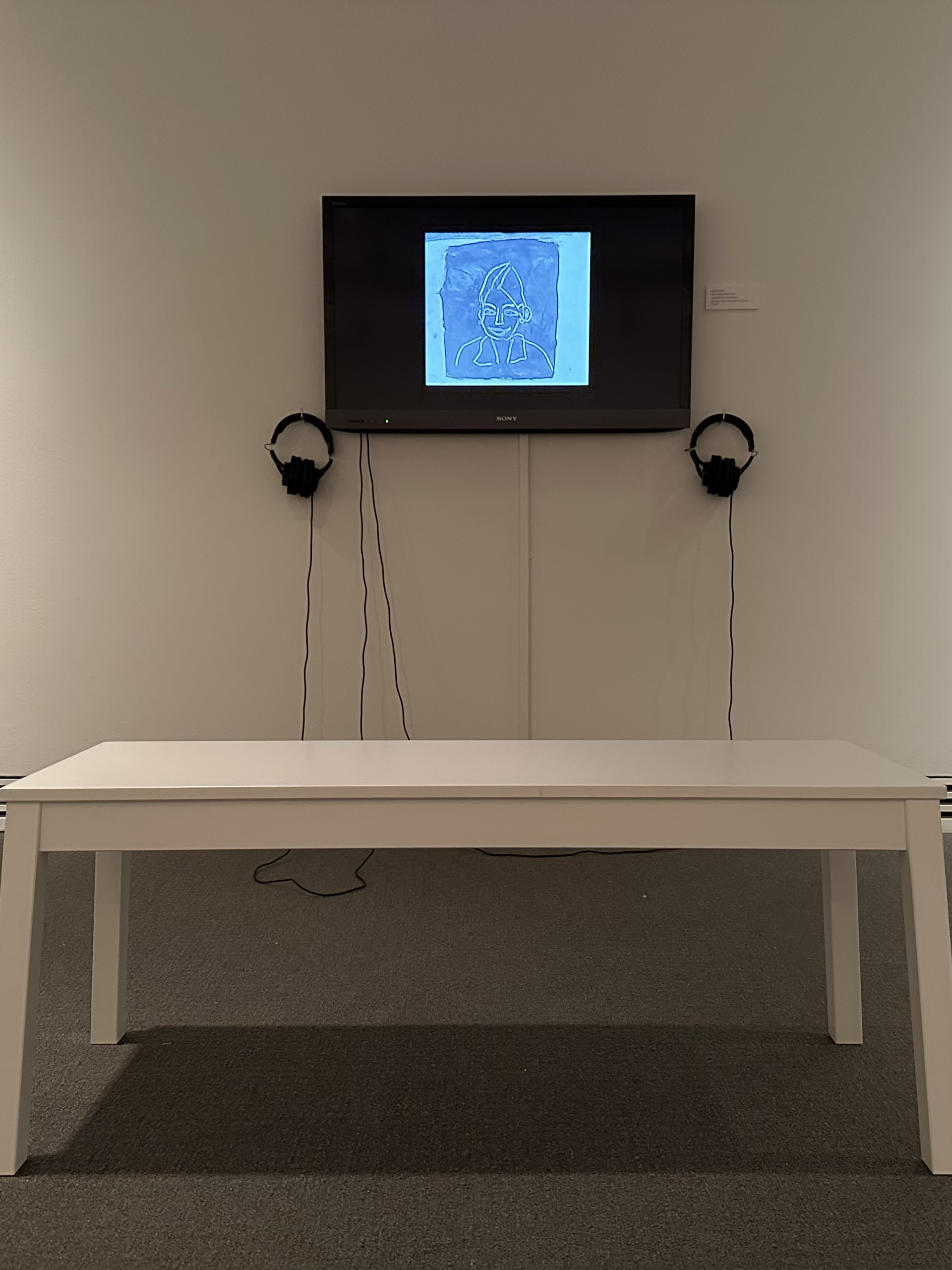
Jagdeep Raina
Ghost in the Fields (2023)
Animated film, 2:28 minute
Courtesy of the artist and Cooper Cole, Toronto
There is no textual explanation for this artwork;
No copyright to demonstrate the video on CUAG Online, please visit in person

Jagdeep Raina
Sarjeet’s offering (2015)
Mixed media on paper
Courtesy of the artist and Cooper Cole, Toronto
There is no textual explanation for this artwork

Jagdeep Raina
Madhur’s Phulkari (2021)
Animated film, 5:16 minutes
Courtesy of the artist and Cooper Cole, Toronto
There is no textual explanation for this artwork;
No copyright to demonstrate the video on CUAG Online, please visit in person
Jagdcop Raina
Invited by Anna Khimasia
Anna writes:
Jagdeep Raina’s work blends personal stories with historical archives, addressing larger narratives of transnational migration and nationhood. Focused on Kashmiri and Punjabi Sikh experiences, Raina’s work makes space for these often-erased histories.
Working in embroidery, drawing and animation, Raina reclaims lost traditions, stories and objects such as the Phulkari, an embroidered cloth unique to the Punjab region. In his animation, Madhur’s Phulkari, the lost craft of the Phulkari and the subsequent disappearance of these embroidered cloths stand in for the erasure and displacement of people and place. Raina dedicates the work “to all the Phulkaris lost in history.”
Raina’s charting of Sikh experiences in Canada is most apparent in this series of drawings, where he reminds us of the histories and sites associated with Sikh immigration. His drawings of the Gur Sikh Temple in Abbotsford, British Columbia, the oldest existing Sikh temple in North America, act as both a reminder and a monument. This approach pushes us to think about the multiple intersections of histories and lived experiences as the past comes to bear on the present.
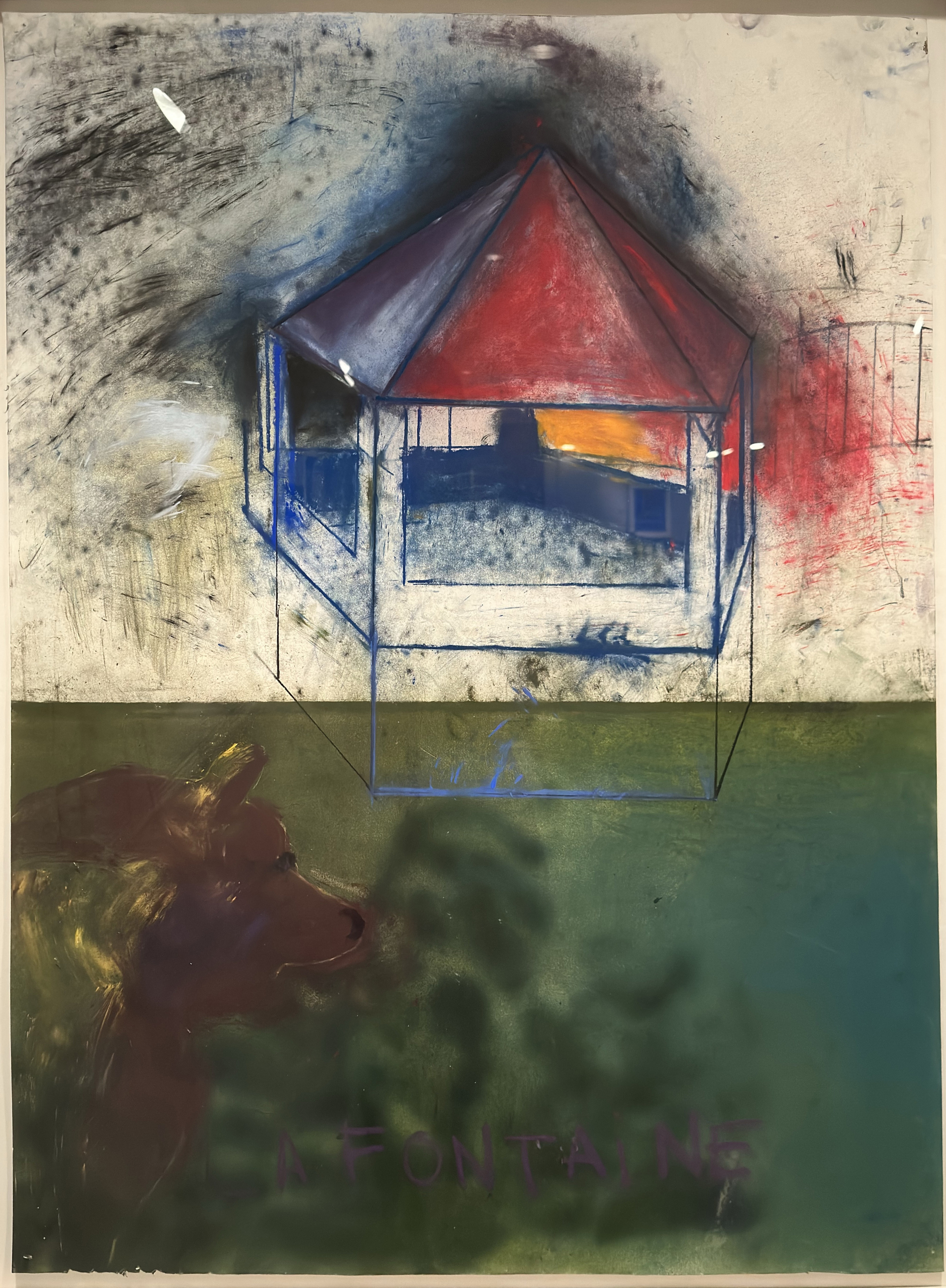
Trevor Gould (Canadian, b. 1951)
Parc Lafontaine (1986)
Chalk pastel on rag paper
Gift of Victoria Henry, 2005
Trevor Gould made this drawing not long after immigrating to Canada from South Africa. He began investigating his adopted city of Montreal, “working out ideas related to site and place,” as he has said…Read More

Gerald McMaster (b. 1953)
Nêhayiw (Plains Cree), Siksika Nation Atim The Dog (1988)
Chalk pastel, acrylic and charcoal on paper
Purchase, 1989
This imposing drawing by Gerald McMaster was purchased in 1989 by art history professor Roger Mesley, during the period he served as volunteer curator of Carlton’s art collection (1982-92)…Read More
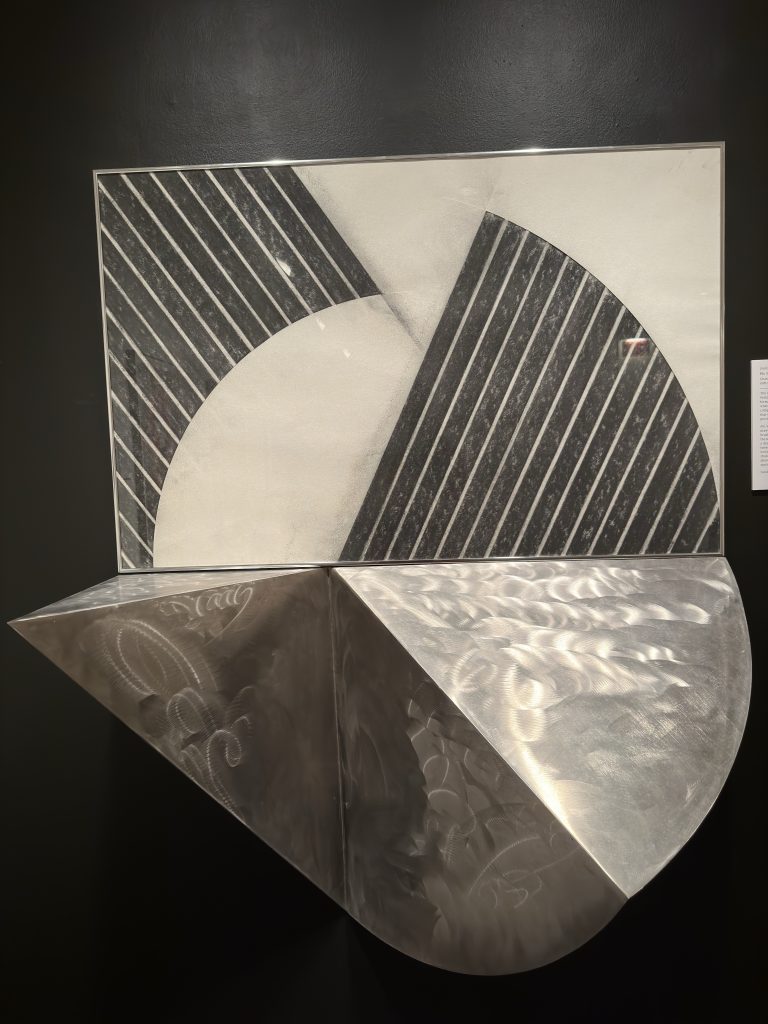
Gunter Note (Canadian, 1938-2000)
Pie (1986)
Charcoal on paper, stainless steel
Gift of Gunter Note, 1996
The German-born, Ottawa-based Gunter Note’s artistic preoccupations were primarily formal. In the…Read More
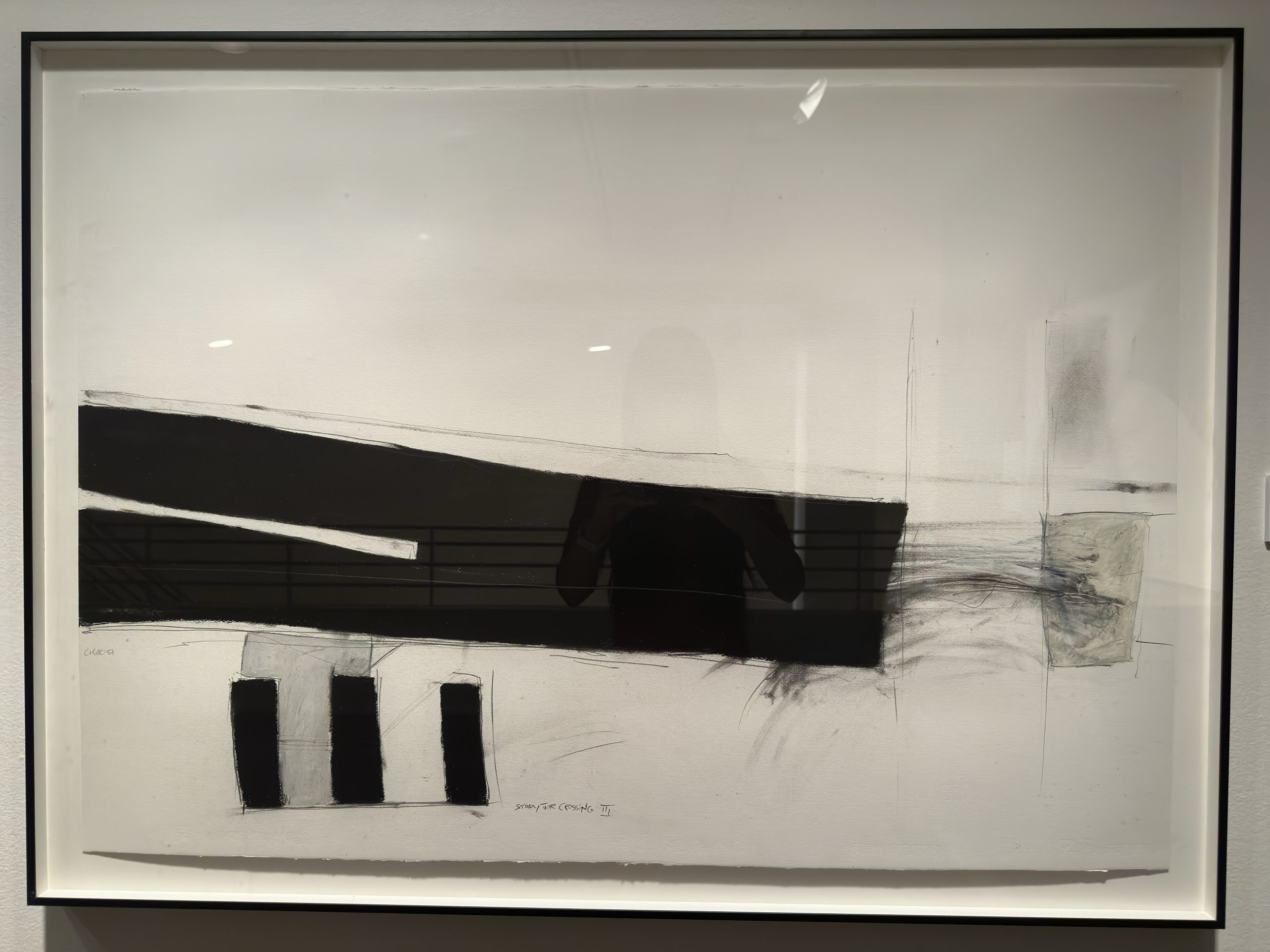
Christopher Kier (Canadian, b. 1959)
Study for Crossing III (1987)
Charcoal, graphite, oil stick and chalk pastel on paper
Purchase, 1987
There is no textual explanation for this artwork

John Scott (Canadian, 1950-2022)
5 Days of Work (1994)
Latex / acrylic, pastel and oil pastel on paper
Gift of Jeffrey Lipson, 1997
The Toronto-based artist lohn Scott was passionate about the idea that art should be accessible to everyone. The prolific artist is known for his instinctual approach to drawing, creating works that are raw and unfiltered…Read More

Duncan de Kergommeaux (Canadian, b. 1927)
Black Drawing No. 22 / 77 (1977)
Charcoal, graphite and blue pastel on paper
Gift of Duncan de Kergommeaux, 1995
The grid, so ubiquitous in post-war art, dominated Duncan de Kergommeaux’s paintings through the 1970s. Late in the decade he decided to make his first grid-based drawings.
…Read More

Ronald Bloore (Canadian, 1925-2009)
Untitled, September 3-5, 1982 (1982)
Sumi ink on paper
Gift of the artist, 1996
In 1980, Ronald Bloore began using white architect’s drafting tape to construct abstract forms and structures on sheets of Arches paper. After brushing black Sumi ink on the paper and allowing it to dry, he removed the tape to…Read More

Robert Houle (b. 1947)
Sandy Bay First Nation
Untitled, from the Summer Mohawk Series (1991)
Acrylic, Mylar and ink on paper
Gift of the Friends of Art History, 1992
There is no textual explanation for this artwork

Gerald Trottier (Canadian, 1925-2004)
Preparatory sketch for Easter Series (1982)
Pen and ink on paper
Gift of Gerald and Irma Trotter, 2002
There is no textual Explanation for this artwork


Cecil Buller (Canadian, 1886-1973)
Untitled (c. 1920s)
Untitled (c. 1920s)
Ink on card
Gift of Sean Murphy, 2007
Cecil Buller trained as a figure painter in Montreal and Paris before focusing on printmaking. These undated drawings were likely inspired by Buller’s time in Paris in the 1920s, a decade when she was very productive.
These drawings evidence Buller’s interest in women who enjoyed the freer, modern fashions and energetic social scene of 1920s Paris. With their art nouveau influence, Buller’s drawings demonstrate her singularly modern, flattened graphic approach, which she combines with eye-catching patterning…Read More

Léon Bellefleur (Canadian, 1910-2007)
Enigmes sous clef (1965)
Pen and ink with ink wash on paper
Gift of Glenn and Barbara McInnes, 1994
The Montreal-born Léon Bellefleur moved to Paris in 1958 on a grant from the Canada Council for the Arts. Traditionally an oil painter, he lived in Paris for many years and worked as part of the Surrealist movement…Read More