
Part 4 – A Little Birdy Told Me Twitter Is Lost

Ariel Aarenau
Dec 15, 2022 (published February 16, 2023) · 5 min read
The layoff email from Twitter is the first email in history that should have been a meeting.
— Chris Bakke (@ChrisJBakke) November 4, 2022
The last few years have been particularly challenging for the company and its users as Twitter faced issues with content moderation such as being charged with amplifying hate speech (O’Neil, 2021). There have also been numerous reports of bots plaguing the platform’s userbase with spam (Frenkel, 2022). As well, there have been several product launches, reliably half-baked and largely disconnected from the platform’s roots. A great example is Fleets, which – ironically in line with its purpose – became ephemeral, with Twitter discontinuing the feature after less than a year (Collins, 2021).
As of late, Twitter has been in a sensitive, temperamental, and vulnerable state. Over the last few years, everyone – ranging from your average user to thought leaders like NYU Stern School of Business professor Scott Galloway and podcaster Kara Swisher – has put a spotlight on Twitter’s underperformance (Galloway & Swisher, 2020). Galloway, in particular, has been critical of Dorsey’s tenure as CEO and the need for change; he even showed willingness to earn a seat on the company’s board through an activist investment movement in 2019 (Galloway, 2022). Finally, consensus boiled over into change: Jack Dorsey, the company’s founder, announced his departure in 2021 and the appointment of Parag Agarwal as CEO (BBC, 2021). Agarwal’s tenure was largely overshadowed by Musk who announced his initial interest in buying the platform just five months after assuming the role (Nieva, 2022).
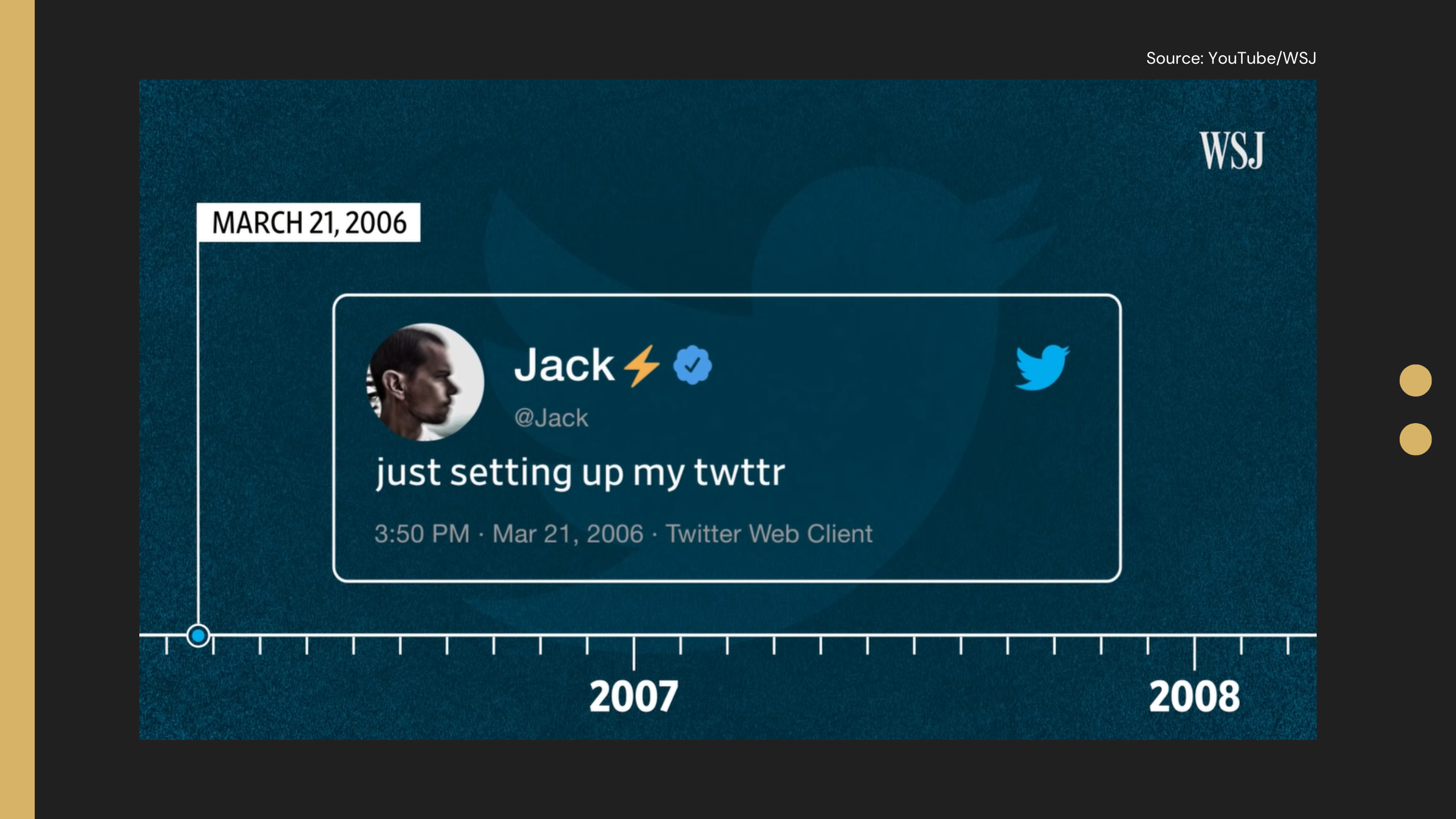
Dorsey founded the company in 2006 after a “daylong brainstorming session” when he was an employee at Odeo (Slattery, 2011). Dorsey’s initial idea for Twitter was using SMS to communicate with a group and update them on your status (hence the 140-character limit). Twitter has of course evolved since then, with its largest change taking place in 2018 when it upped the character limit to 280 (Meyer, 2019). However, its other evolutions have been infrequent and mostly unremarkable (Conger, 2021). This is largely because they have been unrelated to the platform’s roots.
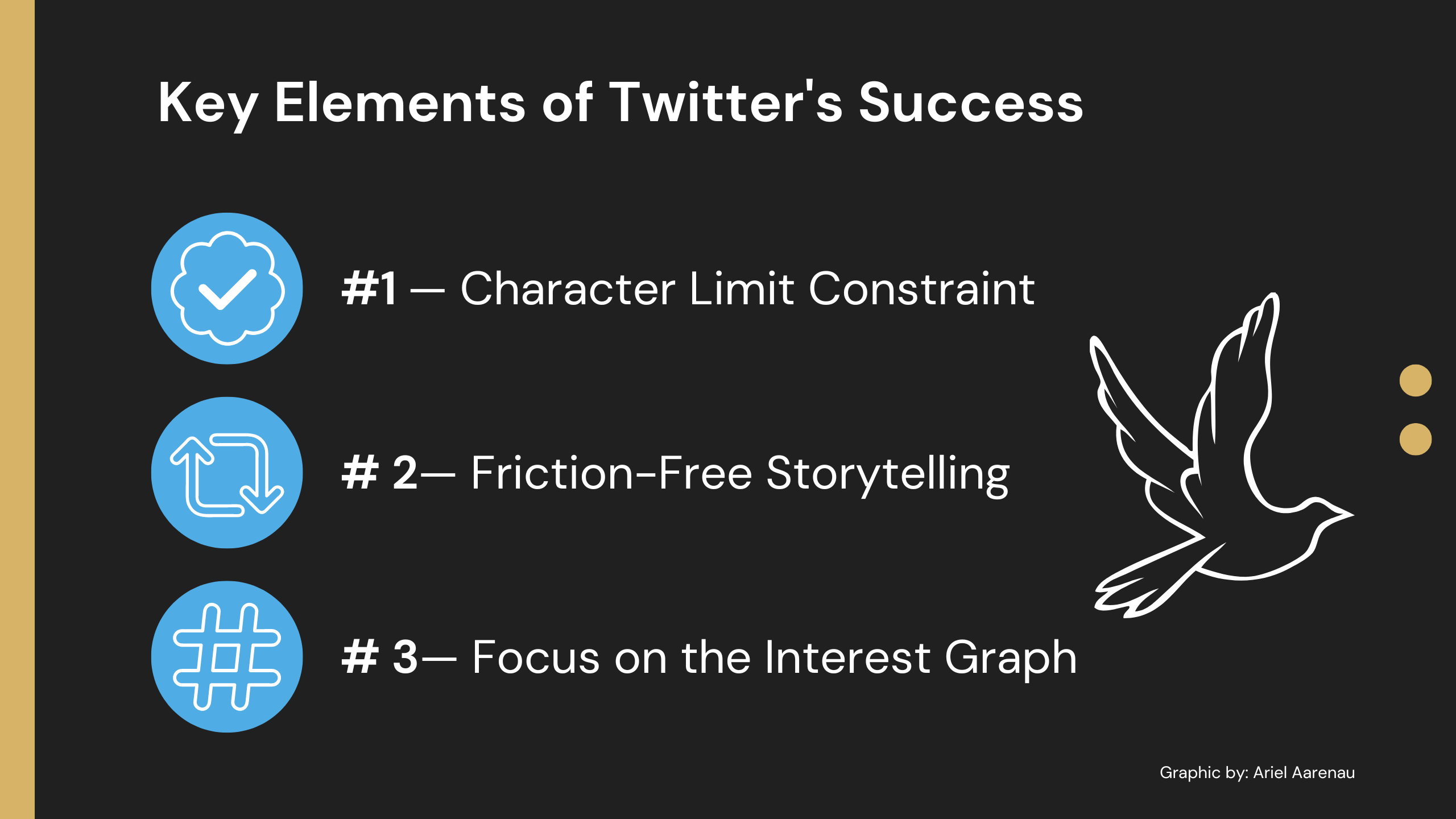
1) As I have noted in previous posts, constraints drive creativity and are often the social media platform’s core differentiator.
2) Twitter’s roots in text-based communication afford users a form of friction-free storytelling that is otherwise hard to find (Gerwitz, 2022). Posting on Twitter is effortless. When benchmarking it against the market of successful social media companies, Twitter requires the least amount of effort. There is no pressure to post the perfect image like with Instagram nor is there a need to film/be featured in a video like with TikTok. The character limit relieves the stressors of grammar, punctuation, and prose often found in longer writing. This ease of use is one reason why public figures ranging from athletes to politicians have taken a liking to the platform, providing straight from the source communications otherwise curated by their media team on other social media platforms.
3) Finally, while Facebook and Instagram have a social graph component, Twitter has an interest graph. An interest graph is an “online representation of the various interests of different individuals,” which, in the case of Twitter, can be easily connected with in the form of interacting and/or following (Nakayashiki, 2022). Twitter’s interest graph gives users a place “to connect with the passions and pursuits that they find meaningful” (Twitter Business, n.d.).
Ariel Aarenau is in his final year of the Bachelor of Media Production and Design program at Carleton University where he is also minoring in Business. The fusion of digital media, design thinking, and innovative business technologies combines both his strengths and passions. He currently works at Deloitte as a Business Analyst focusing on digital strategy, innovation, and transformation advisory projects. Prior to joining Deloitte, Ariel held roles in Multimedia Services at the House of Commons of Canada, Marketing and Business Development for Deloitte Israel, and the Digitally Assisted Storytelling division of Carleton Immersive Media Studio.
BBC. (2021, November 30). Parag Agrawal: India celebrates new Twitter CEO. BBC News. Retrieved November 22, 2022, from https://www.bbc.com/news/world-asia-india-59472676
Capoot, A., & Kolodny, L. (2022, November 13). Twitter cuts a large number of contract workers without giving internal teams a heads up. CNBC. Retrieved November 22, 2022, from https://www.cnbc.com/2022/11/13/twitter-suddenly-cuts-large-number-of-contract-workers.html
Collins, T. (2021, August 3). We hardly knew you: Twitter’s disappearing tweets feature fleets is gone for good. USA Today. Retrieved November 22, 2022, from https://www.usatoday.com/story/tech/2021/07/14/twitter-fleets-ending-snapchat-rival/7964177002/
Conger, K. (2021, February 25). Twitter shakes off the cobwebs with new product plans. The New York Times. Retrieved November 22, 2022, from https://www.nytimes.com/2021/02/25/technology/twitter-product-plans.html
Conger, K., Isaac, M., Mac, R., & Hsu, T. (2022, November 11). Two weeks of chaos: Inside Elon musk’s takeover of Twitter. The New York Times. Retrieved November 22, 2022, from https://www.nytimes.com/2022/11/11/technology/elon-musk-twitter-takeover.html
Frenkel, S. (2022, July 9). What are spam bots and why they’re an issue in Elon Musk’s twitter deal. The New York Times. Retrieved November 22, 2022, from https://www.nytimes.com/2022/07/09/technology/elon-musk-twitter-spam-bots.html
Galloway, S. (2022, April 8). @elon. No Mercy / No Malice. Retrieved November 22, 2022, from https://www.profgalloway.com/elon/
Galloway, S. & Swisher, K. [Pivot with Kara Swisher and Scott Galloway]. (2020, March 10). Pivot Podcast #88: Kara Swisher and Scott Galloway discuss Twitter’s new board, COVID-19 and more [Video]. YouTube. https://youtu.be/biSYtObInlw
Gerwitz, D. (2022, November 10). Why I’m not deleting twitter (yet). ZDNET. Retrieved November 22, 2022, from https://www.zdnet.com/article/why-im-not-deleting-twitter-yet/
Jurecic, Q. (2022, November 20). Trump’s terrifically stupid return to Twitter. The Atlantic. Retrieved November 22, 2022, from https://www.theatlantic.com/ideas/archive/2022/11/elon-musk-donald-trump-twitter/672195/
Kehnscherper, L. (2022, October 30). Musk says he’s chief twit, ‘no idea’ who Twitter’s CEO is. Bloomberg.com. Retrieved November 22, 2022, from https://www.bloomberg.com/news/articles/2022-10-30/musk-says-he-s-chief-twit-no-idea-who-twitter-s-ceo-is
Mac, R., Isaac, M., & Browning, K. (2022, November 18). Elon Musk’s Twitter teeters on the edge after another 1,200 leave. The New York Times. Retrieved November 22, 2022, from https://www.nytimes.com/2022/11/18/technology/elon-musk-twitter-workers-quit.html
Meyer, J. (2019, June 18). History of twitter: Facts and what’s happening now. TheStreet. Retrieved November 22, 2022, from https://www.thestreet.com/technology/history-of-twitter-facts-what-s-happening-in-2019-14995056
Nakayashiki, K. (2022, January 7). Letting the interest graph guide you. Medium. Retrieved November 22, 2022, from https://medium.com/@kazuki_sf_/letting-the-interest-graph-guide-you-faf5e30c178a
Newton, C., & Schiffer, Z. (2022, November 21). Trump is restored to Twitter. Retrieved November 22, 2022, from https://www.platformer.news/p/trump-is-restored-to-twitter
Nieva, R. (2022, October 30). Twitter’s fired CEO Parag Agrawal was never going to please everybody – now it’s Elon Musk’s turn. Forbes. Retrieved November 22, 2022, from https://www.forbes.com/sites/richardnieva/2022/10/28/twitter-parag-agrawal-elon-musk/?sh=2d033ae75a44
O’Neil, C. (2021, February 19). Facebook and Twitter content moderation is failing. Bloomberg.com. Retrieved November 22, 2022, from https://www.bloomberg.com/opinion/articles/2021-02-19/facebook-and-twitter-content-moderation-is-failing
Romano, A. (2022, November 22). The weird sorrow of losing Twitter. Vox. Retrieved November 22, 2022, from https://www.vox.com/culture/2022/11/22/23466381/leaving-twitter-saying-goodbye-social-media
Slattery, B. (2011, March 22). 5 memorable Twitter moments as service turns five: It business. Business Advantage Through Technology. Retrieved November 22, 2022, from https://www.itbusiness.ca/news/5-memorable-twitter-moments-as-service-turns-five/14438
Thomson Reuters. (2022, November 27). Twitter CEO Musk says user signups at all-time high, touts features of “Everything app”. Reuters. Retrieved November 27, 2022, from https://www.reuters.com/technology/twitter-ceo-musk-says-user-signups-all-time-high-touts-features-everything-app-2022-11-27/
Twitter. (n.d.). Interest and follower look-alikes targeting. Twitter Business. Retrieved November 22, 2022, from https://business.twitter.com/en/help/campaign-setup/campaign-targeting/interest-and-follower-targeting.html
More Stories

Part 5 – With Facebook, Instagram, and Twitter in Crisis, A New Generation of Apps Emerges
With Facebook, Instagram, and Twitter each in a state of disrepair, it should be no surprise that competitors are not just emerging but taking off. The first and most prominent competitor is TikTok, an international version of Douyin, which was released in the Chinese market in September 2016. TikTok was then released worldwide following a merger of its parent company with Musical.ly on August 2, 2018.

Part 3 – Can We #ThrowbackThursday Our Way to the Old Instagram?
Founded in 2010 by Kevin Systrom and Mike Krieger, Instagram was an instant success. The app reached over one million users just two months after its release and reached ten million users in its first year. In some respects, its success should have been anything but a surprise: Mark Zuckerberg was an early courter, Jack Dorsey was an avid user, and Marc Andreessen and Chris Sacca had advised from the sidelines.

Part 2 – Facebook Has Had Too Many Facelifts
The year is 2004: Facebook is “open for popular consumption at Harvard University,” but Zuckerberg is anything but a household name (Wayback Machine, n.d.). The dominant social media platform is Myspace, and this continued to be the case for several years. In fact, by the time 2006 came around, Myspace was the most visited internet site in the United States (Lagorio, 2006).

© Copyright 2022. Carleton University School of Journalism and Communication. All rights reserved.