
Part 5 – With Facebook, Instagram, and Twitter in Crisis, A New Generation of Apps Emerges

Ariel Aarenau
Dec 19, 2022 (published February 23, 2023) · 5 min read
The first and most prominent competitor is TikTok, an international version of Douyin, which was released in the Chinese market in September 2016 (Shu, 2020). TikTok was then released worldwide following a merger of its parent company with Musical.ly on August 2, 2018. The short-form video app began to reach substantial market share in early 2020 and subsequently experienced a meteoric rise during the Covid-19 pandemic. TikTok has since announced that it has surpassed one billion users as of September 2021 (Lyons, 2021).
A second competitor is BeReal. Still in its infancy, the app was released in 2020 (Davis, 2022) and has started becoming popular just this year (Fischer, 2022). As of late August 2022, the social media app has over 10 million daily active users (Hutchinson, 2022) and 21.6 million monthly active users (Klingert, 2022). In July of 2022, the non-curated, authenticity-first photo sharing app hit the number one spot on the Apple Appstore in the U.S. (Ortiz, 2022).
While TikTok and BeReal are in two very different leagues, both have made a significant imprint on the social media landscape. TikTok’s success is historic (Perez, 2021) and BeReal is seemingly in the midst of a breakthrough (Brown & James, 2022). The social media space once dominated by Facebook, Instagram, and Twitter now has TikTok as a major competitor and likely has BeReal as a formidable future opponent. Much like how Facebook, Instagram, and Twitter broke into the market, TikTok and BeReal came equipped with a clear storytelling purpose, supporting features that are unique and/or differentiated from the rest of the market, and a set of creative constraints to fuel that purpose. TikTok filled a void left by Vine in short-form video and combined an interest graph with built-in constraints including length of video, vertical formatting, and mobile focus. BeReal is removing the angst and anxiety found within photo-sharing on Instagram and is adding in a plethora of creative constraints that make for a unique storytelling experience (Newton, 2022). Creative constraints within BeReal include simultaneous front and back camera usage, limited ability to post, defined aspect ratio, and the photos only media format. It is as if the founders of both apps read my last four posts and set out to create an app with that information in mind. The context of my posts alongside the rise of TikTok and BeReal almost makes it seem like creating a successful social media app is easy. This, of course, is not the case.
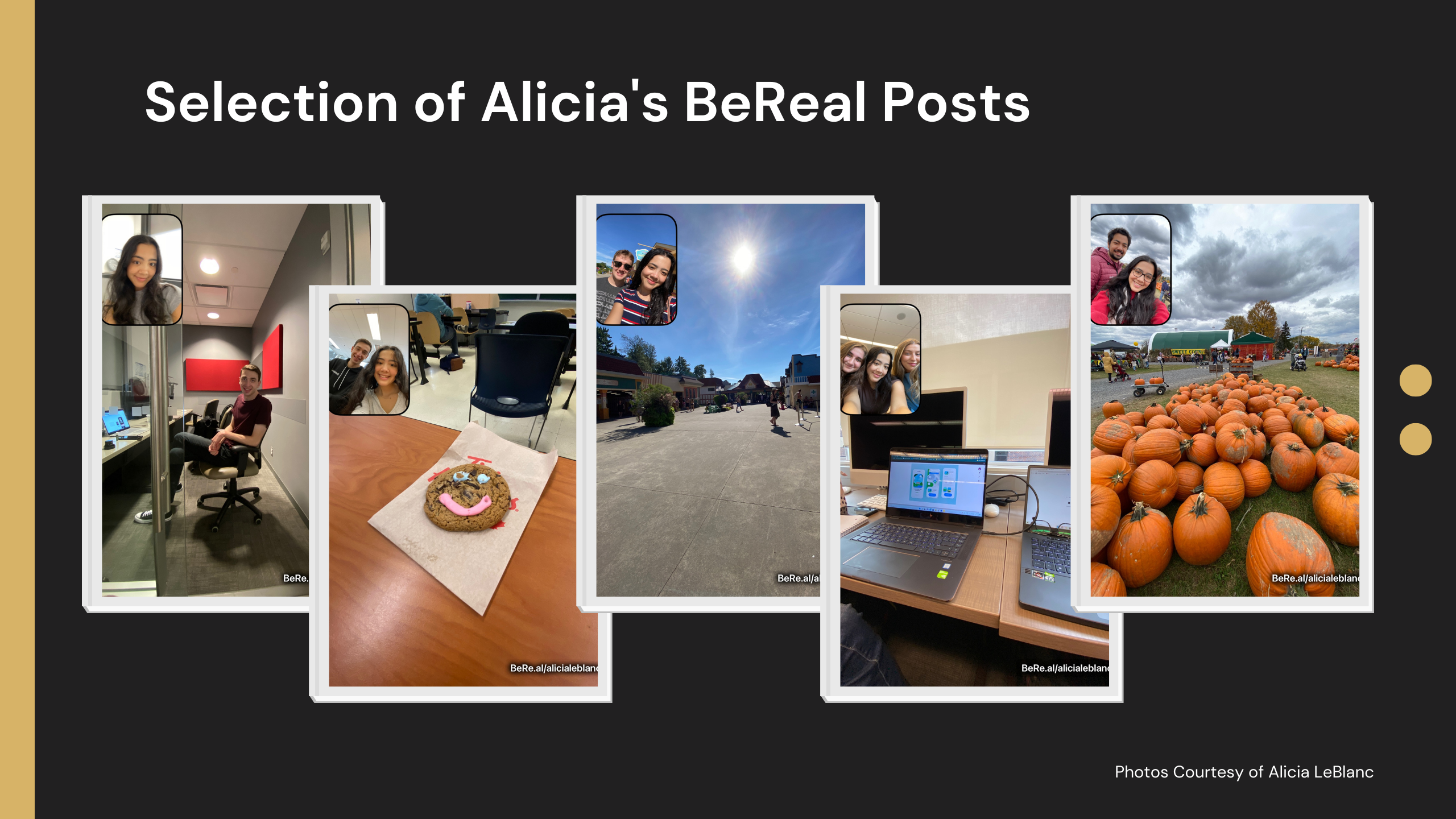
To better understand the complexity and delicateness of social media storytelling and the affordances of TikTok and BeReal, I interviewed two fellow BMPD students, Lea and Alicia. Lea is a successful fashion and lifestyle-based content creator with over 20,000 followers on TikTok. Her previous collaborators include SKIMS and Merit Beauty (Bitzanis, 2022). Alicia is an active BeReal user who has posted on the platform every day since joining the app in July 2022.

1) A social media app should avoid launching features that deviate from its founding purpose
2) Constraints breed creativity (Onarheim & Biskjær, 2013), are fundamental to the storytelling experience, and make the social media app unique/differentiated
3) A social media app can remove and/or lessen the impact of its creative constraints as long as it does not disconnect the app from its purpose
Both Lea and Alicia have accounts on Facebook, Instagram, and Twitter. When reflecting on their relationship with these apps in comparison to TikTok and BeReal, they concluded that these apps were filling a void, offering a differentiated experience, and numbing the discontent they felt in their relationships with Facebook, Instagram, and Twitter. In particular, Lea and Alicia identified Instagram as their old favourite app. They both felt that Instagram’s move to an algorithmically generating feed was disconnected from its roots as a social graph, and that Reels, unlike Stories, was a less than natural product extension and roll-out. Lea noted that Instagram was always “photo first, and video second” and that the addition of Reels is flipping that in a “forced” nature.
As I reflect on the research and interviews conducted for this series, it is clear to me that Facebook, Instagram, and Twitter have indeed evolved into everything platforms, leaving users like Lea and Alicia pressed to find that missing something somewhere else. I guess you can say that as user discontent grew over time (Tik…Tok…Tik…Tok), users decided to it was time to BeReal with themselves and admit Facebook, Instagram and Twitter are in crisis.
Ariel Aarenau is in his final year of the Bachelor of Media Production and Design program at Carleton University where he is also minoring in Business. The fusion of digital media, design thinking, and innovative business technologies combines both his strengths and passions. He currently works at Deloitte as a Business Analyst focusing on digital strategy, innovation, and transformation advisory projects. Prior to joining Deloitte, Ariel held roles in Multimedia Services at the House of Commons of Canada, Marketing and Business Development for Deloitte Israel, and the Digitally Assisted Storytelling division of Carleton Immersive Media Studio.
Bitzanis, L. (2022). Lea Bitzanis Media Kit. [PDF].
Bitzanis, L. (27 November 2022) Interview. Conducted by Ariel Aarenau.
Brown, D., & James, C. (2022, April 20). Why BeReal, a social-media app with no photo filters, is attracting gen Z. The Wall Street Journal. Retrieved November 27, 2022, from https://www.wsj.com/articles/why-BeReal-a-social-media-app-with-no-photo-filters-is-attracting-gen-z-11650456491?st=vs2yrywp8xdjen4&reflink=desktopwebshare_permalink
Davis, W. (2022, April 16). BeReal is gen Z’s new favorite social media app. here’s how it works. NPR. Retrieved November 27, 2022, from https://www.npr.org/2022/04/16/1092814566/BeReal-app-gen-z-download
Fischer, S. (2022, April 11). Gen Z’s new favorite app is growing like crazy. Axios. Retrieved November 27, 2022, from https://www.axios.com/2022/04/11/BeReal-gen-zs-favorite-app-authenticity
Hutchinson, A. (2022, August 24). BeReal rises to 10 million daily active users. Social Media Today. Retrieved November 27, 2022, from https://www.socialmediatoday.com/news/BeReal-rises-to-10-million-daily-active-users/630449/
Klingert, L. (2022, October 14). BeReal is an EU Challenger app to Silicon Valley dominance, but can it last? BeReal is an EU challenger app to Silicon Valley dominance, but can it last? Retrieved November 27, 2022, from https://www.brusselstimes.com/305115/BeReal-app-is-an-eu-challenge-to-silicon-valley-dominance-but-can-it-last
LeBlanc, A. (27 November 2022) Interview. Conducted by Ariel Aarenau.
Lyons, K. (2021, September 27). TikTok says it has passed 1 billion users. The Verge. Retrieved November 27, 2022, from https://www.theverge.com/2021/9/27/22696281/tiktok-1-billion-users
Newton, C. (2022, July 20). Why BeReal is breaking out. The Verge. Retrieved November 27, 2022, from https://www.theverge.com/2022/7/20/23271184/BeReal-app-popularity-memes-tiktok-time-to
Onarheim, B., & Biskjær, M. M. (2013). An Introduction to ‘Creativity Constraints’. In Innovating in Global Markets: Challenges for Sustainable Growth. Proceedings Lappeenranta University of Technology Press.
Ortiz, S. (2022, November 17). What is BeReal? everything you need to know about this fast-growing social media app. ZDNET. Retrieved November 27, 2022, from https://www.zdnet.com/article/what-is-BeReal-everything-you-need-to-know-about-this-fast-growing-social-media-app/
Perez, S. (2021, December 20). TikTok to rank as the third largest social network, 2022 forecast notes. TechCrunch. Retrieved November 27, 2022, from https://techcrunch.com/2021/12/20/tiktok-to-rank-as-the-third-largest-social-network-2022-forecast-notes/
Shu, C. (2020, September 22). TikTok, WeChat and the growing digital divide between the US and China. TechCrunch. Retrieved November 27, 2022, from https://techcrunch.com/2020/09/22/tiktok-wechat-and-the-growing-digital-divide-between-the-u-s-and-china/
More Stories

Part 4 – A Little Birdy Told Me Twitter Is Lost
I write this post amidst ongoing chaos at Twitter HQ. It is November 21, 2022, and a few dozen more Twitter employees have flown away from the nest. Elon Musk is the company’s “Chief Twit”, and his latest decision to reinstate former President Trump’s Twitter account has the world chirping. Since Musk’s ownership, Twitter has shed 60% of its employees between layoffs and attrition, cut 80% of its contractors, and experienced a humiliating Twitter Blue product reconfiguration.

Part 3 – Can We #ThrowbackThursday Our Way to the Old Instagram?
Founded in 2010 by Kevin Systrom and Mike Krieger, Instagram was an instant success. The app reached over one million users just two months after its release and reached ten million users in its first year. In some respects, its success should have been anything but a surprise: Mark Zuckerberg was an early courter, Jack Dorsey was an avid user, and Marc Andreessen and Chris Sacca had advised from the sidelines.

Part 2 – Facebook Has Had Too Many Facelifts
The year is 2004: Facebook is “open for popular consumption at Harvard University,” but Zuckerberg is anything but a household name (Wayback Machine, n.d.). The dominant social media platform is Myspace, and this continued to be the case for several years. In fact, by the time 2006 came around, Myspace was the most visited internet site in the United States (Lagorio, 2006).

© Copyright 2022. Carleton University School of Journalism and Communication. All rights reserved.