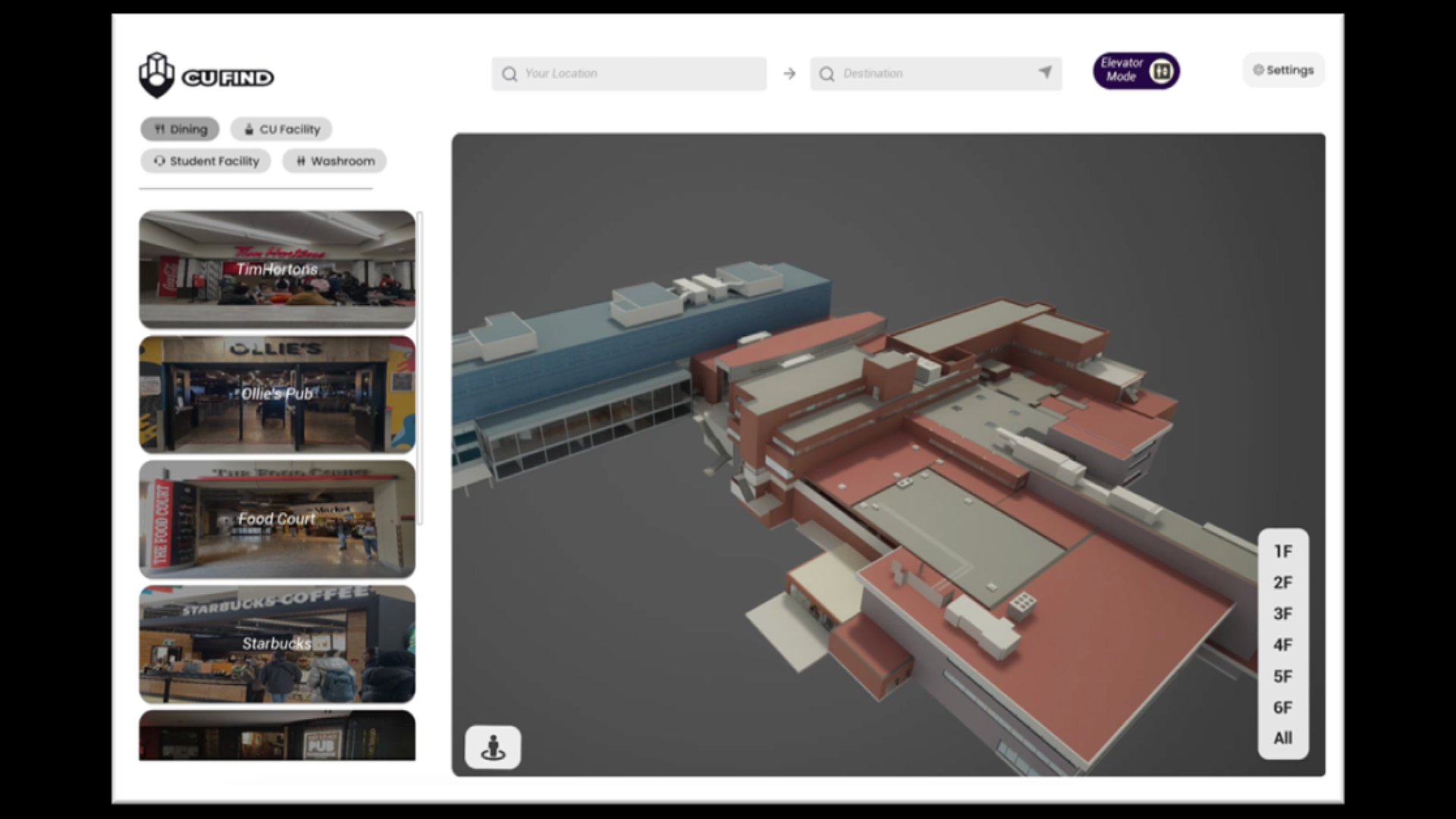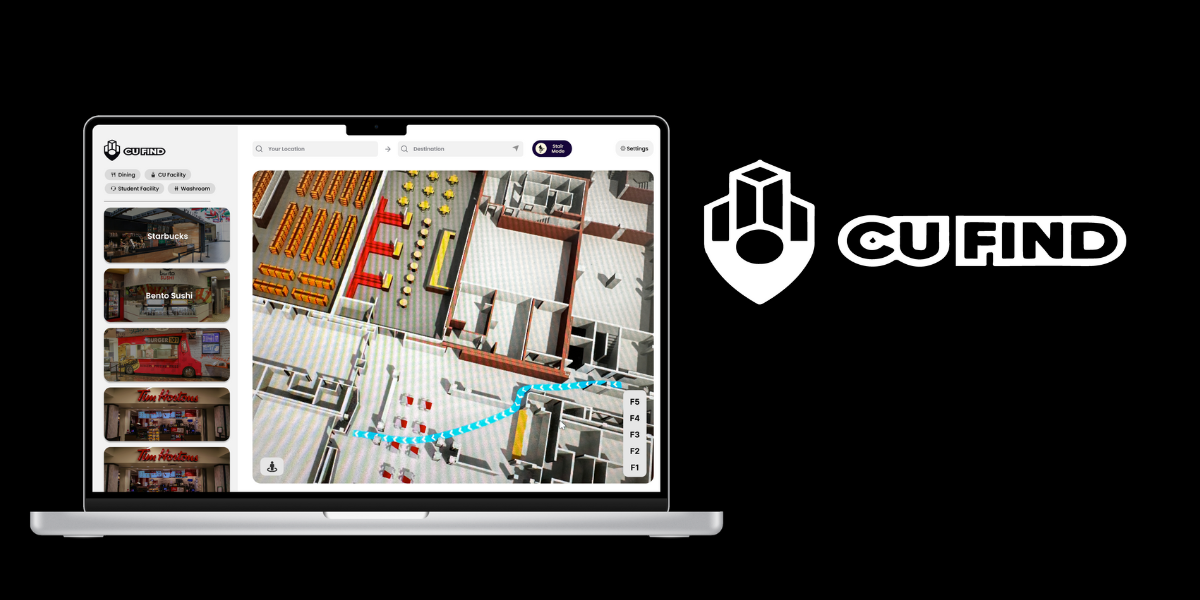
CU FInd
GROUP MEMBERS
- Yuchen Hu
- Xinpeng Liu
- Joey Liu
- Krystal Shao
INDUSTRY PARTNER
Carleton Immersive Media Studio (CIMS)
PROJECT DESCRIPTION
The CUFind app is an indoor navigation solution aimed at enhancing the navigation and accessibility experiences within the Carleton University campus buildings. The increasing size of the campus and facilities pose a challenge for students, staff, and visitors in terms of finding their way around the premises. To address this issue, the project provided a comprehensive and user-friendly solution for indoor navigation, utilizing modern technology and design principles. The Carleton University Indoor Wayfinding system makes navigating the campus buildings a seamless experience for all users, regardless of whether they are searching for a specific classroom, office, or facility. The target audience for the CUFind app are individuals who visit the Carleton University Centre in search of specific facilities or services. Given the diverse needs of the target audience, they have been categorized based on their requirements.
GROUP MEMBERS
- Yuchen Hu
- Xinpeng Liu
- Joey Liu
- Krystal Shao
INDUSTRY PARTNER
Carleton Immersive Media Studio (CIMS)

final project
CU Find is an indoor navigation app that provides a clear and usable directional guide for students and staff to navigate within the building by using the digital campus building model provided by Carleton Immersive Media Studio (CIMS). CIMS is engaged in theoretical and applied multidisciplinary research concerned with the integration of new and emerging digital technologies into non- or semi-digital workflows. They provided a complex digital model of the entire campus to support the CU Find team. The CU Find team believes that wayfinding could be a sticky problem when people arrive in a completely new environment and many Carleton students still have problems with finding a specific location within a building based on the survey result. On top of that, returning to school is particularly challenging after two years of global epidemics and online courses, and it is a time-consuming thing for students to get familiar with all the services and classrooms without any guide. Since the original model involves a programming and game engine field that are not so familiar with, the whole project is not only challenged by the integration of these components but also the UI/UX design of accessibility and the implementation.
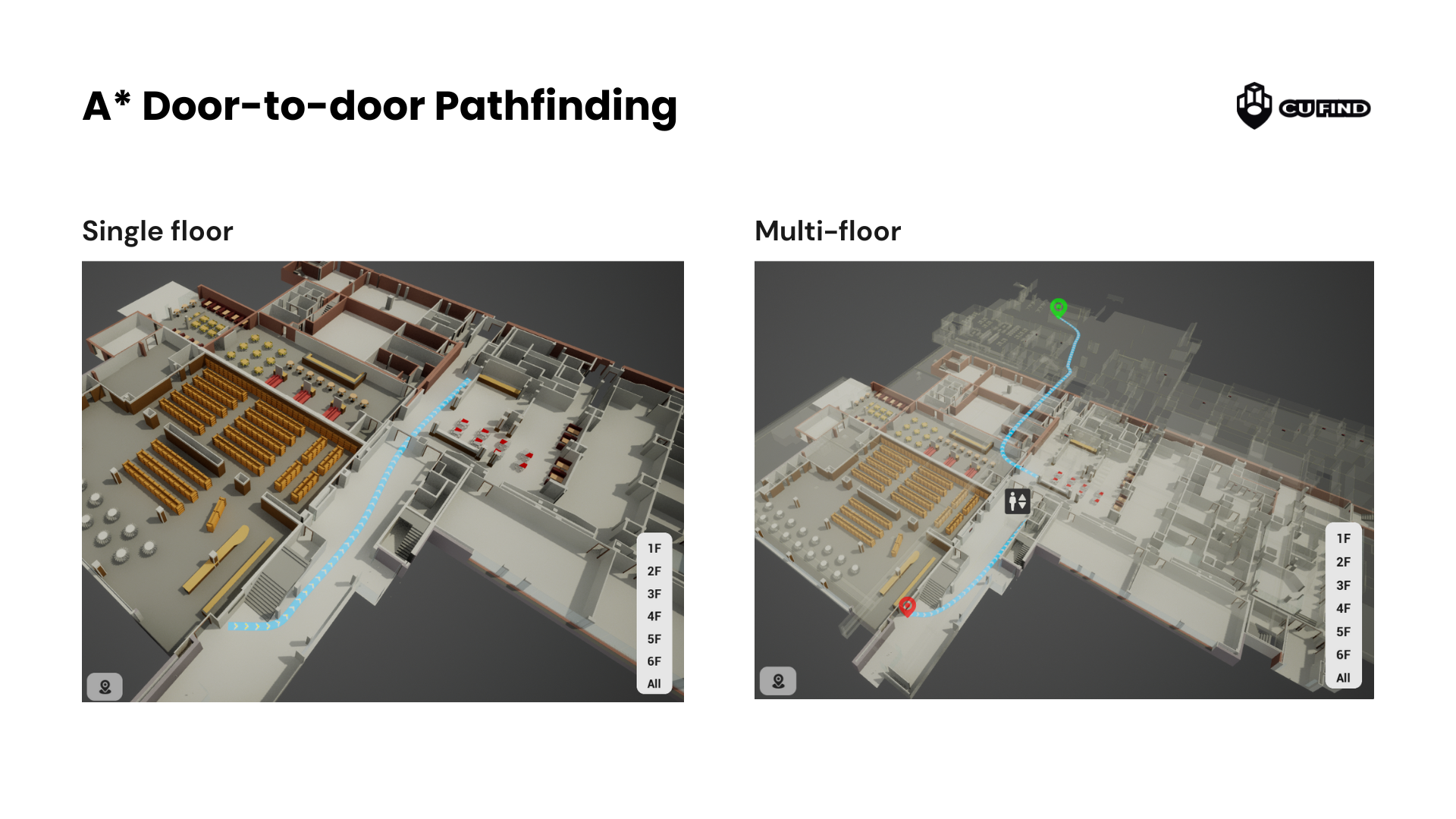
CU Find, is designed specifically for the University Centre at Carleton University. It provides users with turn-by-turn directions to specific indoor locations within the building, such as classrooms, offices, and dining services. The app also enables cross-floor navigation using Dijkstra’s algorithm, which helps users to find the shortest path between two points. The development of CU Find has been an iterative process, with the team testing and refining the app over time.
Development Process
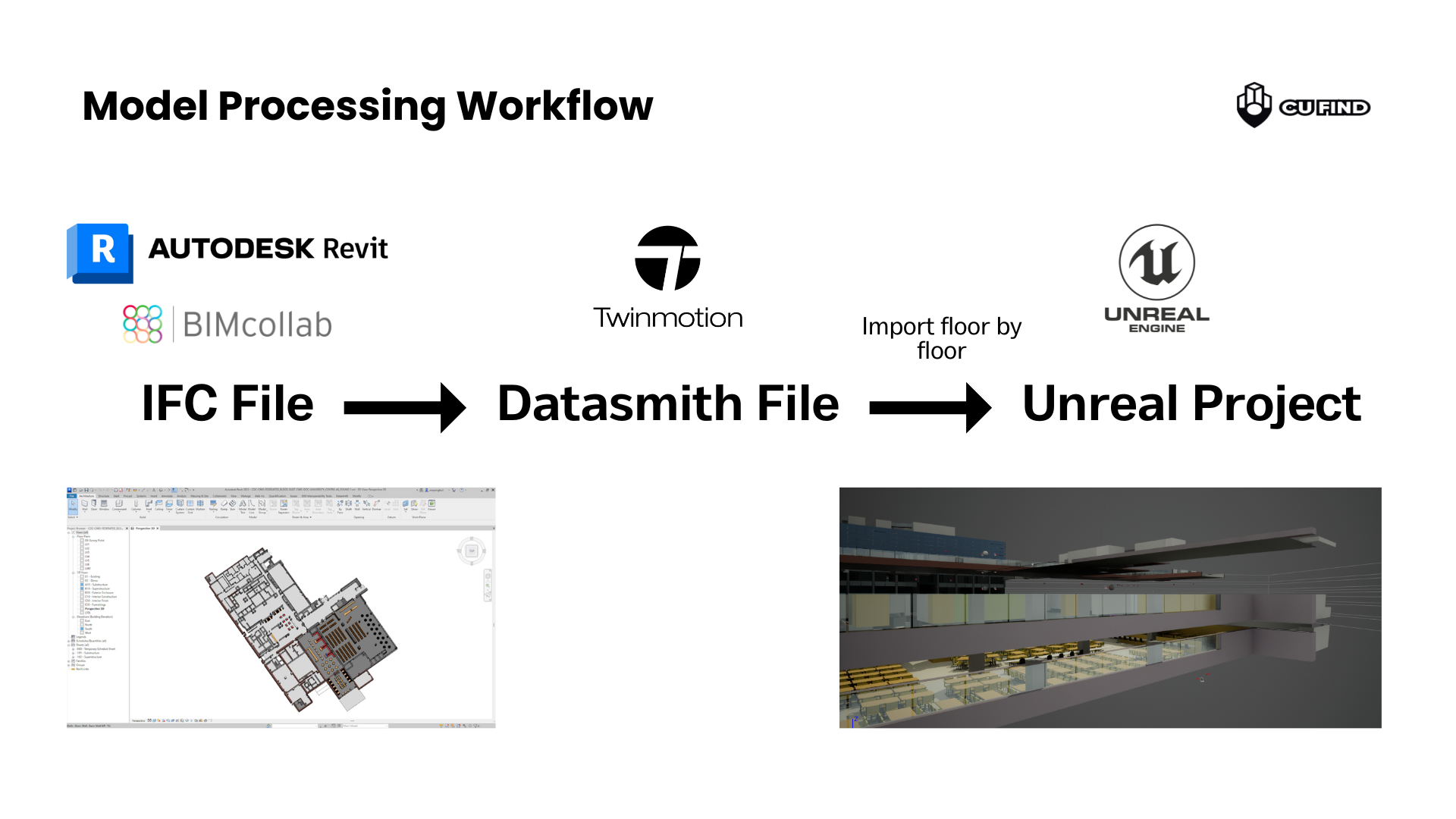
CU Find was created by converting a Building Information Model (BIM) developed by Carleton Immersive Media Studio (CIMS) into an UnReal Engine project using the Datasmith plug-in. Rather than splitting the original scene components (solid body based) into separate FBX chunks (meshes based), Datasmith devised a novel import solution that re-utilizes assets and textures to minimize workload. Although this approach sacrificed some of the original accuracies, the primary objective of CU Find was to establish a cost-effective workflow. By pre-processing the layering in Revit, we achieved a layered view during the import process into the game engine instead of treating the whole building as a heavy entity.
Implementation of Wayfinding
The implementation of an effective wayfinding algorithm is crucial for indoor navigation systems. One widely-used approach is the A* (A-star) algorithm, which is a pathfinding and graph traversal algorithm that relies on nodes to determine the shortest path between two points. The concept of nodes was originally developed in the field of urban design, and CU find has taken it and implemented it into our indoor navigation calculations. In indoor wayfinding, nodes represent key decision points, such as elevators and stairs, to achieve cross floor navigation.
UI/UX Design
In addition to the technical aspects of navigating in a virtual world, the UI/UX design was critical to ensuring accessibility for all users. In the creation of CU Find, the UI/UX design team focused on how to make it accessible to all students and ensure that users could clearly identify where they were and where they were headed. The importance of these design decisions was not only to provide a user-friendly experience but also to improve the utility and efficiency of the application.